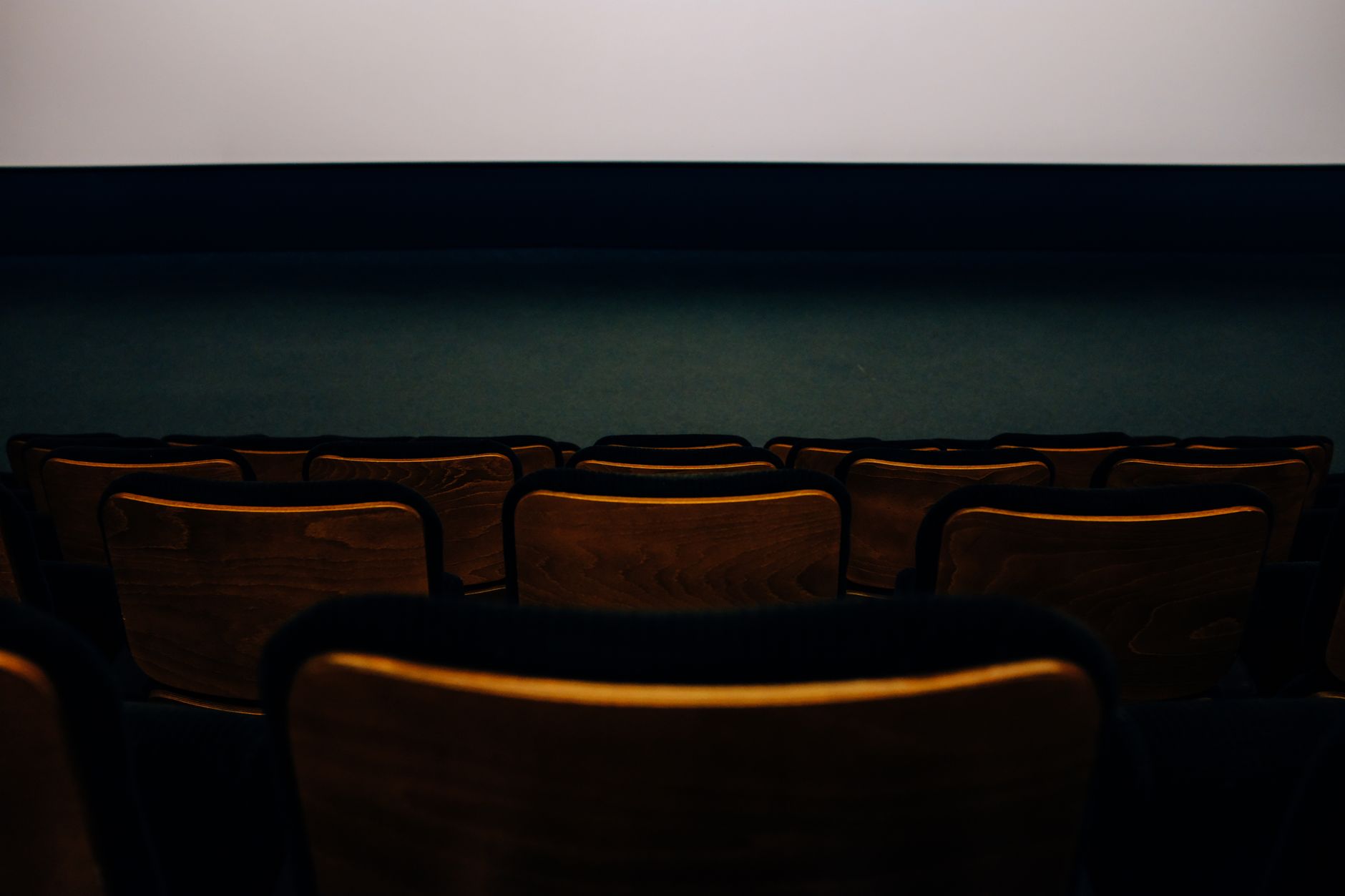
A cinema in a horror film is never just a place to watch movies. It's a carefully engineered trap: a dark room full of strangers, a single lit screen demanding your attention, and a social contract that keeps you in your seat even when every instinct says run. Horror has known this for decades, and when the genre turns its eye on the movie theatre itself, it finds a space that does half the work already.
The logic is simple and brutal. A haunted house traps a family. A basement traps one person. A cinema traps hundreds, all of them voluntarily blinded by the dark, all of them trained to sit still and watch. The genre doesn't have to build that trap from scratch. The audience built it themselves when they bought the ticket.
Watching as vulnerability
What makes the cinema so useful to horror is the act of spectatorship itself. Watching is passive. It's something done to you as much as by you. Your eyes are fixed forward, your body is still, and your attention is surrendered to whatever the screen demands. Horror understands this surrender and uses it.
Peter Bogdanovich's Targets (1968) is probably the most precise deployment of this idea. A sniper hides behind the screen at a drive-in and shoots through it at the audience. The film-within-the-film keeps playing. People die watching. The horror isn't supernatural: it's architectural, procedural, and entirely about the specific vulnerability of sitting in the dark facing a light source. Bogdanovich understood that the drive-in audience was already positioned as a target, physically and metaphorically, and he pressed that image to its conclusion.
The indoor theatre works differently but just as effectively. Rows of seated bodies, aisles that funnel movement, an exit at the back that requires walking away from the light. Darkness behind you. Darkness beside you. The stranger two seats over whose face you can't see.
The screen as portal and threat
Once you accept that a cinema is a site of vulnerability, the screen becomes the obvious point of intrusion. If the room is a trap, the screen is the door the monster uses.
This idea reaches its most elegant form in Ringu (1998), where the television screen is the portal Sadako uses to cross from her world into the viewer's. It isn't a cinema screen, but the logic is identical: a fixed frame, a passive viewer, and a monster that knows exactly how to exploit the relationship between the watcher and the watched. The terror of Ringu depends entirely on the idea that watching something can let it out. Cinemas amplify that anxiety simply by making it communal. If the television set lets one person in, what does a forty-foot screen in a room of three hundred do?
Horror has also used the cinema screen as a site of contamination. In Demons (1985), Dario Lamberto Bava's Italian splatter film, an audience watching a horror film inside a sealed theatre becomes infected by the very thing they're watching. The screen is a wound. The film is the vector. The genre turns the audience into participants in their own destruction, which is exactly the metaphor that every piece of meta-horror has been reaching for since.
The audience as mob and victim
When a cinema fills with panicking bodies, it becomes something different again. It's no longer a room full of individuals: it's a crowd, and crowds have their own horror grammar. Exits become bottlenecks. Darkness becomes chaos. The social order that keeps people in their seats inverts into something stampeding and anonymous.
This is the other side of the cinema's horror utility. Where Targets uses the audience's stillness against them, films that stage disasters or infestations inside theatres use their number. Too many people, too few exits, too much dark. The mass is as dangerous as the monster, sometimes more so.
Joe Dante's Matinee (1993) plays this more gently, staging a mock monster movie inside a Florida cinema during the Cuban Missile Crisis and finding the comedy in an audience that doesn't know whether to be more afraid of the film or the news. But the underlying point is real. The cinema is a place where collective emotion gets manufactured and released, and horror knows that manufactured emotion can tip.
The projectionist and the person behind the curtain
Horror films set in cinemas don't only exploit the seat. They exploit the architecture. The projection booth above the audience, sealed off and elevated, is exactly the kind of space the genre reaches for: a room with a view, a vantage point that sees without being seen. The projectionist is the hidden figure who controls what the audience perceives, and that control, in horror, is never benign.
This maps cleanly onto Peeping Tom (1960), which isn't set in a cinema but whose entire architecture is about the camera as weapon and the act of filming as violation. Mark Lewis controls what his subjects see: their own deaths, reflected back at them on a mirror attached to his camera. He's a projectionist of terror, and the people watching him in the cinema become implicated in what he does. Michael Powell understood that watching and doing are never fully separate acts, and the cinema space makes that implication literal.
The projection booth also gives horror a character type it loves: the solitary technician who knows the building better than anyone, who works in the dark, and who is either the last person who can save the audience or the first person the monster claims. Both versions appear regularly. Both work.
Self-reference and the meta-trap
Once horror sets itself inside a cinema, it can't avoid a certain self-consciousness. The audience watching the film is watching an audience watching a film. The genre has used this recursion in a few different ways, some genuinely unsettling and some merely clever.
The genuinely unsettling version asks whether the audience in the film and the audience watching the film are in the same situation. If the fictional viewers are being hunted or infected or destroyed by what they're watching, the real audience has to decide whether the same logic applies to them. Funny Games (1997) does this without a cinema: Michael Haneke breaks the fourth wall and addresses the viewer directly, indicting them for watching violence. The cinema as horror setting does it structurally, without anyone needing to speak to camera. The mise en scène makes the argument.
The merely clever version is self-referential horror that uses the cinema to signal its own awareness of genre conventions without pressing the idea anywhere uncomfortable. It's the difference between Scream's opening, which uses the audience's knowledge of horror films to construct a genuinely terrifying scene, and a lesser film that name-drops the genre without earning it.
What the cinema knows that other spaces don't
Every horror setting has a core logic. The basement is about what's buried. The attic is about what's preserved. The hospital is about submission and the body's betrayal. The cinema's core logic is about consent.
You chose to come here. You sat down in the dark. You agreed to watch. Horror set inside a cinema makes that consent the trap. You handed over your autonomy at the door, surrendered your eyes to the screen, let the dark press in from every side, and trusted that nothing would use that surrender against you. The genre's answer is consistent: something always will.
That's what makes the cinema a more precisely calibrated horror space than it first appears. It doesn't need an ancient curse or a haunted history. The building works as intended. That's the point.