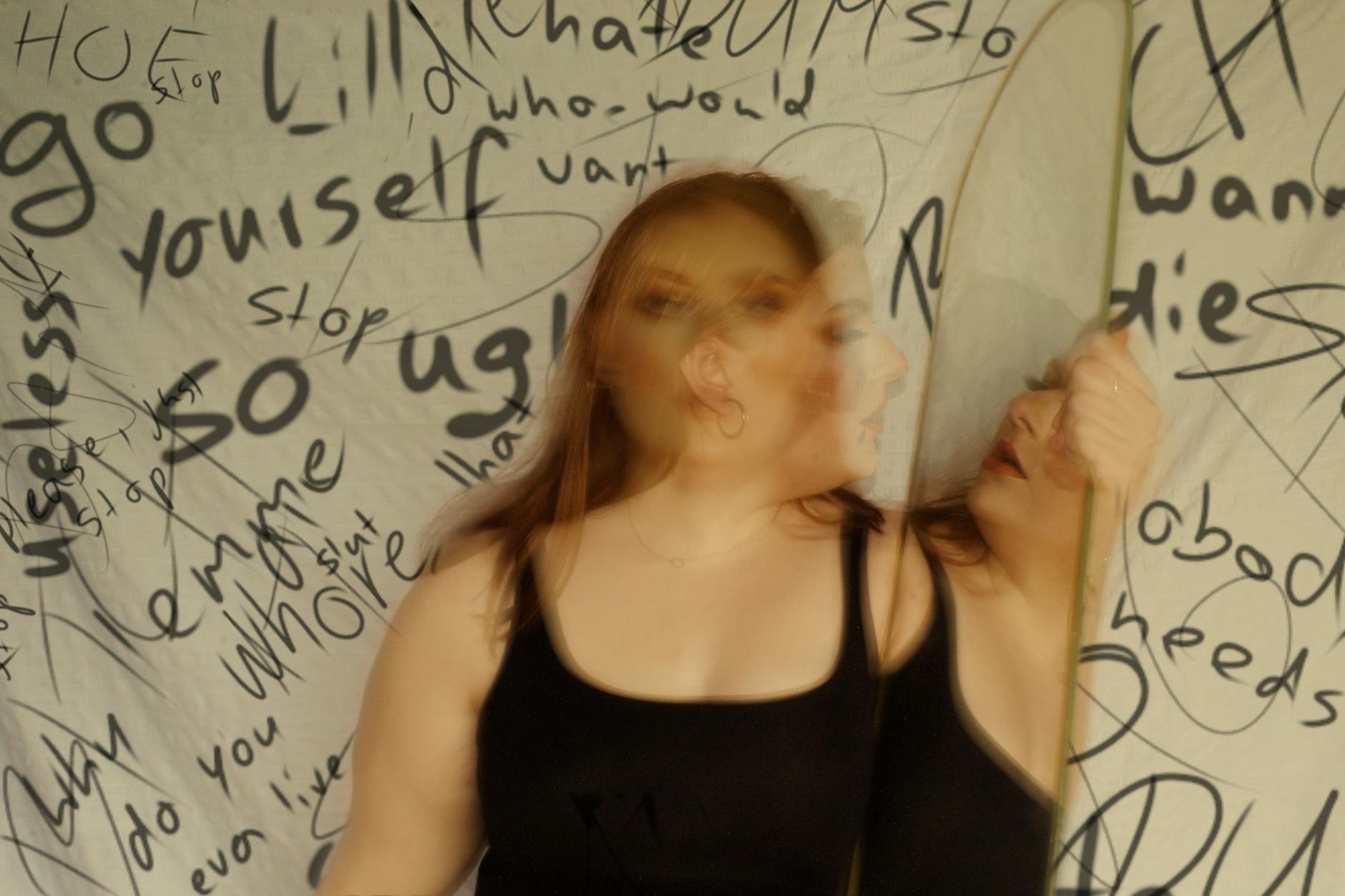
The doppelgänger is horror's cruelest premise. Not a monster from elsewhere, not a ghost with unfinished business, but a replica of you: your face, your voice, possibly your memories. The horror of the double doesn't ask you to fear something alien. It asks you to fear yourself, or at least what you might become, or what might already exist alongside you without your knowledge. Few devices in the genre have proven as durable or as philosophically slippery.
Where the double comes from
The word itself is German, literally "double walker," and the concept predates cinema by centuries. Germanic folklore treated the doppelgänger as an omen of death. To see your own double was to receive a warning. Edgar Allan Poe used it in "William Wilson" in 1839, Dostoevsky made it the engine of psychological collapse in The Double in 1846. By the time horror cinema arrived, the doppelgänger was already a well-worn existential threat. What cinema added was the face, made large, unmistakable, and impossible to look away from.
Early horror used the double as a kind of moral parable. The evil twin, the hidden self, the suppressed nature made visible. Robert Louis Stevenson's Jekyll and Hyde is the template: the double as the part of us we refuse to acknowledge. Horror inherited this structure and then, over decades, started pulling it apart.
What the double actually does to the viewer
There's a specific kind of unease the doppelgänger generates that differs from standard monster horror. When a creature attacks, the viewer's fear is directed outward. When a double appears, the dread turns inward. You start asking questions that don't have clean answers. Which one is real? How would I know? If the copy is perfect, does the original retain any special status?
Jordan Peele's Us (2019) makes this the engine of its entire structure. The Tethered aren't simply murderous versions of the Wilson family. They're a mirror held at the wrong angle, reflecting something about labour, about suppression, about what gets discarded so that comfort can exist. Lupita Nyong'o plays both Adelaide and Red with such precision that the film keeps you genuinely uncertain which identity has the stronger claim to humanity. The doppelgänger here isn't an intruder. It's an argument.
Compare that with The One I Love (2014), a quieter and less celebrated film in which a couple discover their holiday retreat houses copies of themselves who are, in every measurable way, better partners. The horror isn't violence. It's the suggestion that you could be replaced by a version of yourself that tries harder. That the copy might be the improvement.
The double as identity theft
Some of the most effective doppelgänger horror works through the fear of substitution. Not the fear of being confronted by your double, but the fear of being quietly replaced by it. Invasion of the Body Snatchers (in every version from 1956 onward) runs on this dread: the people you love have been swapped for replicas that function identically but feel, somehow, wrong. The wrongness can't be articulated. It's a texture, a tone.
This is where the doppelgänger intersects with the unreliable narrator in horror. The substitution story and the unreliable perspective story share a common anxiety: the fear that your perception of reality cannot be trusted. In both cases, the horror is not located in a visible threat but in the collapse of the ground you stand on. The monster isn't coming for you. Your reality is already compromised.
Denis Villeneuve's Enemy (2013), adapted from José Saramago's novel, goes further. It refuses to resolve whether the two identical men are even separate beings, or whether one is a projection of the other's fractured psychology. The film's final image remains one of cinema's most startling because it refuses to answer the question it has spent 90 minutes asking. The doppelgänger, here, is less a plot device than a diagnostic tool for the mind that created it.
Body horror and the copy that degrades
A persistent strand of doppelgänger horror connects the double to bodily decay. The copy isn't perfect. It starts to slip. It shows its seams. This version of the premise carries a different freight: the fear that something wearing your skin won't be able to maintain the performance. David Cronenberg explored this territory obsessively. Dead Ringers (1988) places identical twin gynaecologists at the centre of a story about shared and splitting identity, and the horror of the film is that the twins become doppelgängers of each other. Each one is the other's worst reflection.
The degrading double connects naturally to Cronenberg's body horror, which treats the physical self as something unstable, provisional, capable of becoming something else entirely. If the body can change, then the self attached to it can change. And if the self can change, there's no guarantee the person left at the end of the process is recognisably you.
The shadow self in folk tradition
Not all doppelgänger horror arrives with a full-formed double. Sometimes it's more like a shadow that starts behaving independently. Folk horror has a rich tradition of stories in which a person's second self, sometimes called a fetch, detaches and acts against the original's interests or will. This version of the double is less about psychological fragmentation and more about a world that contains more selves than one body can account for.
It's worth noting how differently the double functions across cultural horror traditions. Japanese horror tends to produce entities that aren't quite copies: the onryō in Ringu isn't a double of any living person, but her wrongness, her distorted form, registers as a kind of grotesque mirror of grief and female suppression. The idea of the self turned malevolent, given shape, persists even when the monster isn't technically a replica.
Why the doppelgänger refuses to go away
Horror keeps returning to the double because the anxiety it encodes never fully resolves. Identity, in the 21st century, is more contested than ever. Questions about authenticity, about performance, about whether the self you present online corresponds to anything real, all of these feed into the genre's renewed appetite for doppelgänger stories.
The recent wave of films using the double as a central device, from Us to Dual (2022) to Infinity Pool (2023), suggests that the premise has found a new relevance. When the self is understood as a construction, as something performed rather than simply inhabited, the arrival of a copy that constructs itself just as convincingly becomes genuinely destabilising. The double was once an omen. Now it's closer to a diagnosis.
Good doppelgänger horror doesn't let you leave with an answer. It leaves you watching the door, wondering whether the person who opened it is the same one who closed it on the way in.