Repulsion (1965) is Roman Polanski's second feature and the first of the three films that make up his informal Apartment Trilogy, alongside Rosemary's Baby and The Tenant. Polanski shot it in London on a tight budget, in black and white, and with a leading actress who was 21 years old and had barely spoken English on screen. The result is one of the most precise and genuinely disturbing films in horror cinema. It doesn't rely on a monster. It is a portrait of a mind disintegrating, and the flat in Kensington where it mostly takes place becomes as claustrophobic as anything four walls have ever contained.
What the film is about
Carol Ledoux (Catherine Deneuve) works as a manicurist in a London salon. She lives with her sister Helen, who shares the flat with a married boyfriend, Michael. Carol barely speaks. She stares. She flinches from men who attempt physical contact. When Helen and Michael leave for an Italian holiday, Carol is left alone, and the flat begins to change. Walls crack. Hands reach from plaster. Corridors stretch. A skinned rabbit, forgotten on a plate, rots with methodical screen time.
Polanski isn't interested in explaining Carol's condition. The film offers no traumatic flashback sequence, no diagnosis, no helpful expository scene. A photograph glimpsed in the opening frames suggests abuse in childhood, but Polanski places it there and leaves it alone. The horror isn't rooted in a why. It's rooted in the texture of how Carol experiences reality, which is Polanski's real subject.
Deneuve carries everything
Deneuve's performance is extraordinary partly because so little of it is spoken. She moves through the flat in a kind of sleepwalker's daze, her face registering sensation rather than thought. A man's touch on her shoulder reads on her face like a burn. She scrubs at her mouth after a kiss she doesn't want. When she begins to kill, there's no rage in it. She looks stunned by what her own hands are doing.
It's a performance built from physical detail. The way she sits, the angle of her head, the quality of her blankness. Polanski and cinematographer Gilbert Taylor shoot her in tight close-up often enough that the audience starts feeling trapped inside Carol's perspective, but wide enough at other moments to make her look small inside rooms that are visibly closing around her. The split walls and reaching arms are practical effects, not optical trickery. They feel organic to the space because Taylor's camera treats them as though they're real.
The flat as a horror location
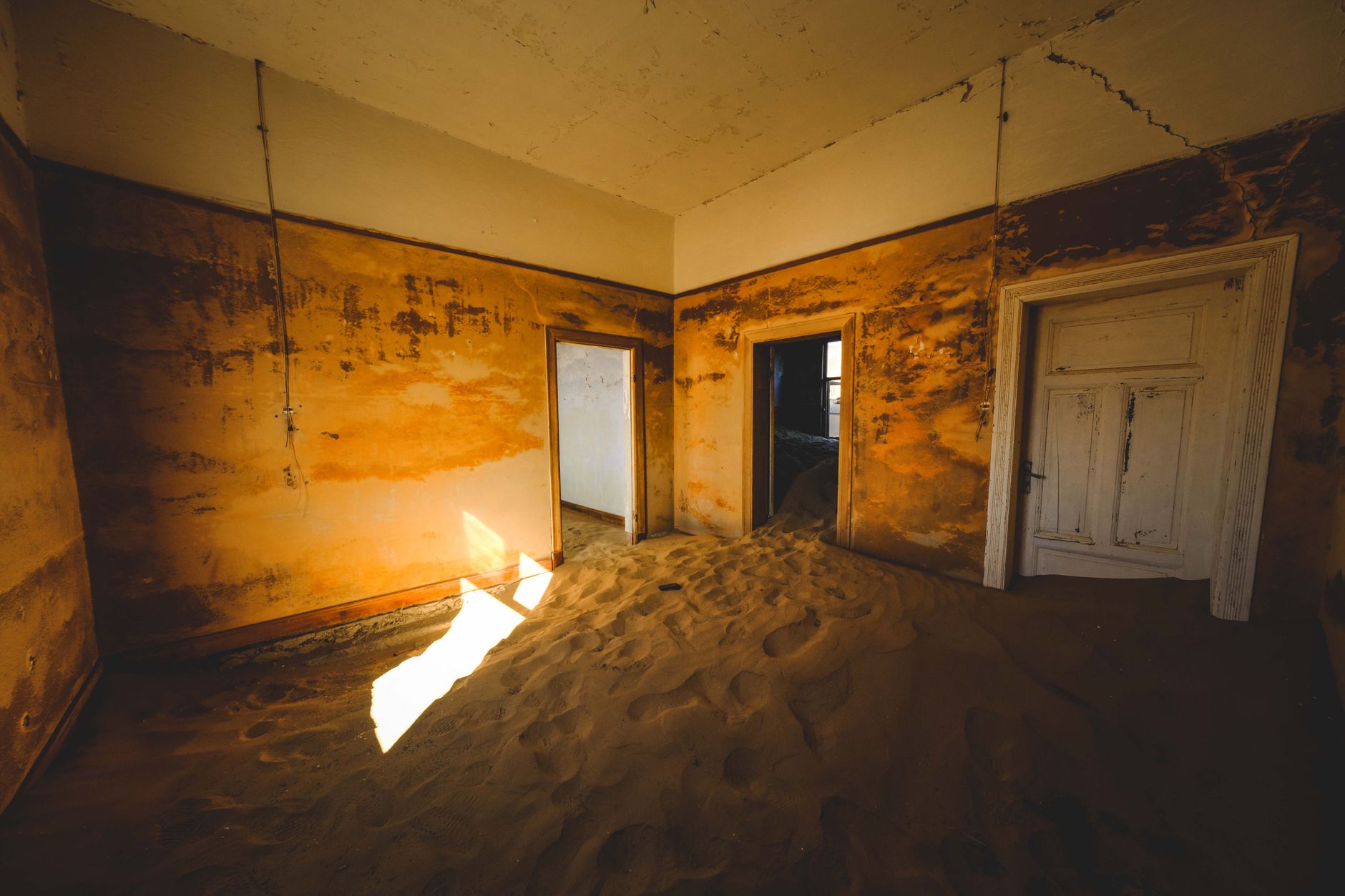
What makes Repulsion endure is what Polanski does with the apartment itself. The film belongs to a tradition of horror that Robert Wise explored in The Haunting (1963): architecture as psychological state. The Kensington flat doesn't haunt Carol the way a conventional ghost would. It mirrors her. Its walls crack when she cracks. The corridors distort when her sense of space distorts. By the film's final third, the flat looks as though it has been squeezed through a fever.
Sound design does as much work as the visuals. A dripping tap. A buzzing fly. Church bells. Footsteps in an empty hallway. Polanski uses silence aggressively, cutting sound entirely at moments of maximum dread, so that the next noise lands with double the impact. The rabbit's decay is scored by ambient room tone and nothing else. You notice every creak.
Polanski's formal control
Polanski was 31 when he made Repulsion, and he shoots with the precision of someone who has worked out exactly what every frame needs to do. The film opens in extreme close-up on Carol's eye, an image that establishes the film's central concern immediately: we are going to spend 104 minutes inside a perception that cannot be trusted. The closing shot mirrors it. Polanski brackets the film with eyes and never lets you forget you're watching through someone else's lens.
The pacing is patient in the first act, accelerating into genuine nightmare by the second. Polanski doesn't rush the rot. He lets the rabbit sit. He lets the flat settle into its altered geometry. By the time the first act of violence arrives, the film has built so much interior pressure that the release is shocking not because it's graphic (the staging is relatively restrained by contemporary standards) but because the inevitability of it has been accumulating for an hour.
Where it sits in horror history
Repulsion arrived a year after Psycho's aftershocks were still being felt, and it borrows from Hitchcock's playbook: the point-of-view horror, the ordinary domestic space made strange, the killer as someone psychologically legible rather than supernaturally evil. But Polanski does something Hitchcock didn't attempt. He refuses to let the audience stand outside Carol's experience and judge it. The film asks you to inhabit her, not analyse her. That's a harder and more uncomfortable position.
The Apartment Trilogy as a whole is Polanski's sustained argument that the home is the most dangerous space in horror. Rosemary's Baby (1968) makes the same case using paranoia about neighbours; Repulsion makes it using the terror of being left alone inside your own head. Both films are about women in spaces where no one listens to what they say. Both are still painfully current.
Repulsion doesn't offer resolution. The final shot doesn't explain anything. Polanski gives you the image in the photograph, and then he walks away. What happened to Carol, and what will happen after the credits, isn't his concern. The film's job is to leave you feeling, for a few unsettled hours, what it is like to live inside a mind that the world keeps pressing on from every direction. It does that job completely.
The verdict
Repulsion (1965) is essential horror cinema. Deneuve's performance, Taylor's cinematography, and Polanski's rigorous formal control combine to produce something that has not dated in sixty years. It is one of the genre's most intelligent examinations of psychological collapse, and one of the few films that genuinely makes the viewer feel confined. Watch it alone. Watch it twice. The second viewing is worse.