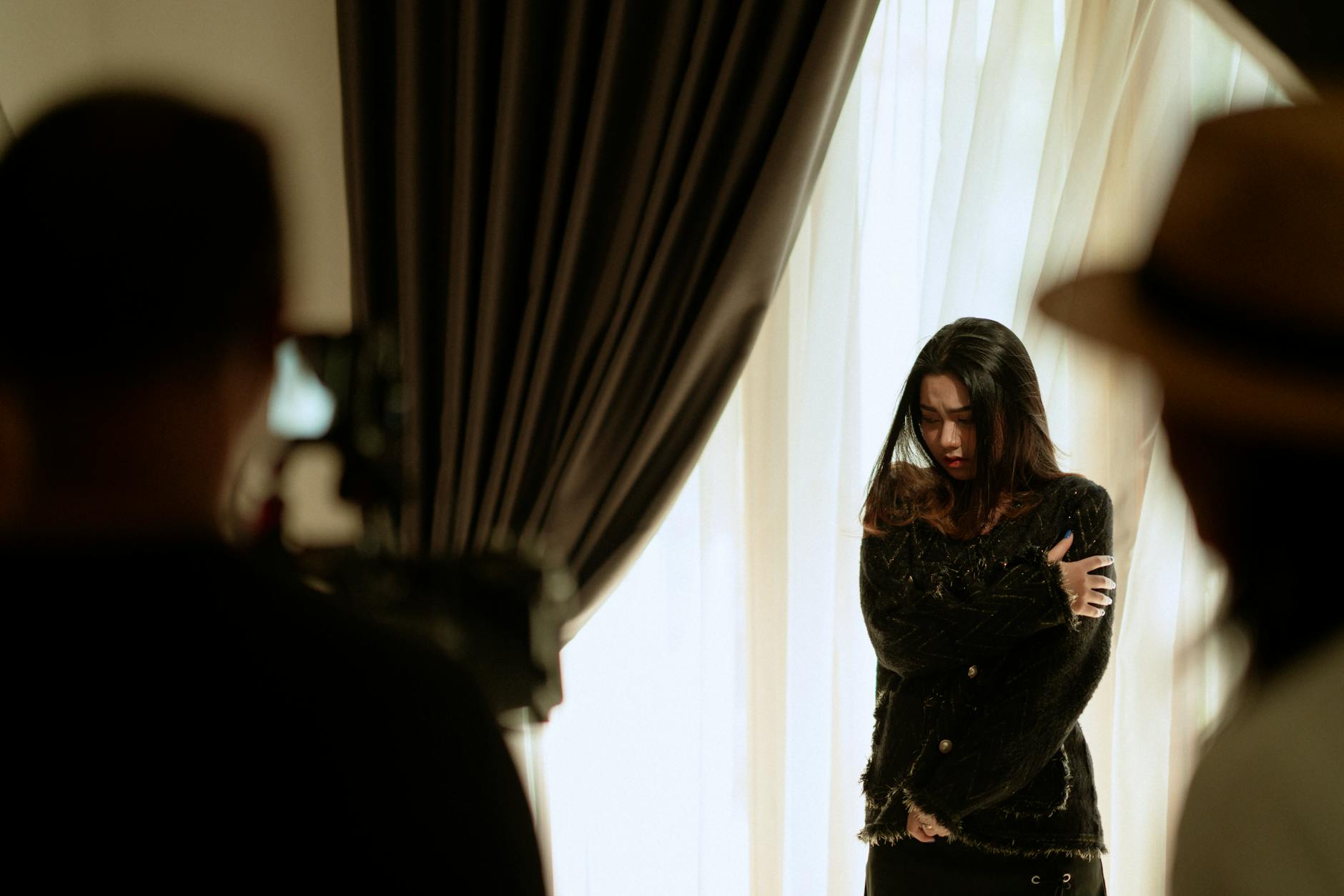
Starry Eyes (2014) is the horror film that takes the oldest story in Los Angeles and asks what it would look like if the bargain were literal. Kevin Kolsch and Dennis Widmyer's debut feature turns the casting couch, the rebranded self, the slow erosion of identity that Hollywood demands into a body horror narrative so committed to its own logic that it becomes genuinely disturbing. It isn't subtle. It doesn't want to be.
Sarah Walker (Alex Essoe) works at a Hooter's-style burger chain called Big Taters, shares a house with a cluster of aspiring creatives, and auditions constantly for parts she never gets. She's not passive. She practices alone in her bathroom, contorting her face in the mirror with an intensity that already reads as something off. When she lands an audition with a production company called Astraeus Pictures, she freezes up, breaks down in a toilet cubicle, and starts pulling out her hair. A casting assistant follows her in. She's seen the episode before. She finds it interesting.
The architecture of the deal
What Kolsch and Widmyer understand is that the horror of Hollywood desperation is structural. Sarah doesn't fall victim to a sudden predator. She moves toward Astraeus in stages, each one a rational response to a situation that has been carefully arranged. The film presents this as a series of increasingly transgressive auditions: the first asks her to strip psychologically, the second physically, and the third asks for something the film is too smart to name explicitly until it's far too late.
This is where Starry Eyes earns its comparison to Rosemary's Baby (1968), another film where an institution recruits its victim through incremental consent rather than brute force. Both films understand that the most effective horror isn't imposed from outside. It's invited in by someone who wants something badly enough to stop asking questions. Sarah's arc is almost identical in structure to Rosemary Woodhouse's: social isolation, the discrediting of allies, the gradual physical transformation that reads as success before it reveals itself as destruction.
Alex Essoe carries the film almost entirely on her own performance. She won't be unfamiliar to horror fans now, but in 2014 Starry Eyes was her first significant role, and she commits to a level of physical and emotional degradation that most actors would negotiate around. Her Sarah is not sympathetic in the conventional sense. She's vain, she's cruel to her friends, she dismisses genuine affection. But Essoe makes every one of those qualities feel inevitable given the environment she's been placed in. Los Angeles, the film argues, trains people to treat each other as obstacles.
Body horror as career ladder
The film's second half shifts into overt body horror, and this is where some viewers tap out. The transformation Sarah undergoes is not metaphorical. Hair falls out. Skin deteriorates. She vomits. She dies, technically, and comes back as something that fits the role Astraeus had in mind for her all along. Kolsch and Widmyer shoot the transformation sequences with a commitment to practical effects that gives the film a texture entirely its own.
It's worth placing this in a tradition. The body horror logic here is closest to Videodrome (1983), in which a person's exposure to a signal system rewrites them from the inside out. Where Cronenberg's film uses television as the corrupting medium, Starry Eyes uses the film industry itself. The casting session replaces the broadcast signal. The producer replaces the broadcast executive. The corruption is professional before it's physical.
The film draws sharp lines around Sarah's social world too. Her housemates are creative people who talk constantly about their projects and produce almost none of them. They occupy the same aspirational bracket as Sarah but without her self-destructive drive. The film doesn't romanticise them either. They are petty, judgmental, and performatively supportive in ways that read as passive competition. Sarah's ultimate rejection of that world is horrifying. It's also, in a register the film earns precisely because it never winks at the audience, understandable.
What the film gets right
Starry Eyes gets the texture of creative desperation exactly right. The indignity of bad day jobs. The specific loneliness of watching a peer succeed. The exhausting performance of confidence at auditions that go nowhere. These sections of the film, before anything supernatural occurs, are the scariest parts, because they are simply accurate.
The production company Astraeus is depicted as old money Satanism, and the film isn't interested in explaining the theology. There are robes. There is a producer who speaks in the register of a studio executive and the cadence of a cult leader. There are things glimpsed at the edge of frame that are never clarified. The film trusts its own imagery enough not to illustrate it.
Kolsch and Widmyer went on to direct the 2019 Pet Sematary remake, a much larger and more contested production. Starry Eyes, made for a reported $50,000 raised through Kickstarter, remains the more coherent statement. It has a thesis and it holds it. Fame costs everything, it says. Not metaphorically. Not eventually. Right now, in this room, with these people watching.
A word on its flaws
The film isn't without problems. The pacing in the middle section drags. A subplot involving a more successful female peer feels underwritten and functions mainly as a mechanism for Sarah's envy rather than a character in its own right. Some of the gore in the final act tips from visceral into gratuitous in ways that don't pay off thematically. These are real complaints, not minor quibbles.
But they don't undo what works. Starry Eyes arrived in a year full of strong horror, alongside films like It Follows (2014), and it holds its ground in that company. It's a film with a specific argument and the nerve to follow it through. For a debut made on almost no money, that's more than enough.
Alex Essoe's performance alone is worth the watch. She makes Sarah's destruction feel earned and terrible in equal measure, which is the only way this story works. You have to believe she would choose this. Essoe makes you believe it completely.