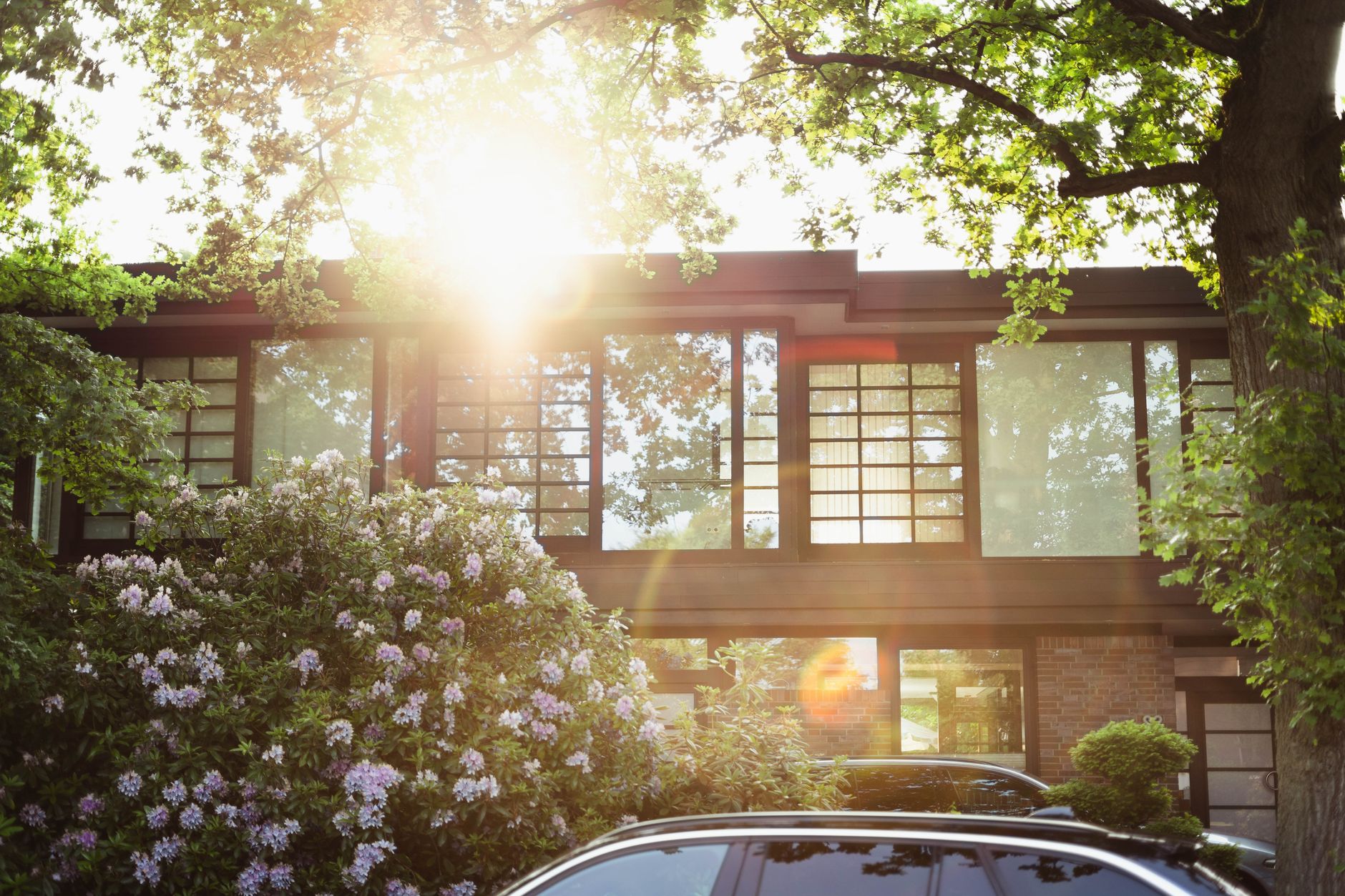
The House Next Door by Anne Rivers Siddons is the 1978 haunted house novel that refuses to look like one. There's no crumbling Victorian facade, no locked attic, no bloodstained wallpaper. The house at the centre of this book is a triumph of modern architecture: glass walls, cantilevered decks, clean lines that catch the light of an Atlanta suburb like something from an award-winning design journal. That beauty is part of the trap. Siddons understood that a house doesn't have to be ugly to be evil, and The House Next Door is the proof.
What the book is about
Colquitt and Walter Kennedy are a comfortable, childless couple living a comfortable life in a comfortable Atlanta neighbourhood. They're the kind of people who host dinner parties and know their neighbours by name. When an elegant new house goes up on the vacant lot next door, Colquitt is initially charmed. The architect, Kim Dolan, has designed something genuinely beautiful. The Kennedys become fond of him and his wife. Then people start moving in, and things start going wrong.
Siddons doesn't rush this. The horror arrives in three distinct movements, each centred on a different family who occupies the house. The first family suffers a social catastrophe. The second loses something worse. By the third, Colquitt and Walter understand what the house does: it finds a person's deepest fault line and presses on it until something breaks. It doesn't manufacture evil. It reveals what was already there and amplifies it until the occupants destroy themselves or each other.
That premise is considerably more frightening than a ghost. Siddons is writing about entropy, about the hidden structural damage in people's lives that ordinary social routine keeps sealed. The house is an instrument of exposure.
Siddons's voice and the novel's unusual register
The novel is told from Colquitt's first-person perspective, and that choice matters enormously. Colquitt is observant, articulate, and deeply embedded in Southern social convention. She notices things. She also, for a long stretch, refuses to name what she's noticing. Her voice is that of a reasonable woman applying reasonable explanations to unreasonable events, and the gap between what she describes and what she allows herself to conclude generates a sustained unease that most horror fiction never achieves.
Siddons came from literary fiction. Her debut, Heartbreak Hotel, published the year before this one, was a mainstream Southern novel. The House Next Door is her only horror novel, and it shows the discipline of a writer who didn't think genre gave her permission to be sloppy. Every sentence earns its place. The pacing is slow by design, the way The Little Stranger by Sarah Waters is slow: the dread accumulates through what characters fail to say as much as what they do.
Stephen King selected The House Next Door for his 1981 nonfiction survey of horror, Danse Macabre, naming it one of the finest horror novels of its era. That endorsement eventually found the book a wider audience, but Siddons never returned to the genre. This remains a standalone, which gives it an odd, singular quality in her bibliography.
The house as character
The architectural precision of the house is not decoration. Siddons researched it. The house functions as a character with its own logic: it is beautiful in a way that disarms people, open in a way that leaves them exposed, and positioned in a way that makes it impossible for Colquitt and Walter to ignore. They can see directly into the lives of whoever lives there. That's the novel's central irony. The most architecturally transparent house in the street is also the one hiding the most terrible secret.
This connects The House Next Door to the tradition of haunted house fiction that locates the horror in architecture itself rather than in something that simply happens to occupy a building. The house in House of Leaves by Mark Z. Danielewski operates on similar principles: the structure is the antagonist, not the contents. Siddons gets there first and does it with considerably less typographic violence.
What makes the house's malevolence so specific is that it never acts directly. Nothing jumps out. No one is physically dragged anywhere. The house simply watches and waits for the moment when its occupants' own suppressed natures take over. It's a haunting built from psychology rather than the supernatural, though Siddons leaves just enough ambiguity to let readers argue the point.
Southern Gothic and its anxieties
Siddons plants the novel firmly in Atlanta's professional class, and she knows that world from the inside. The neighbours are friendly, the streets are leafy, and everyone keeps up appearances with a kind of cheerful ferocity. This is exactly the right setting for a horror novel about what comfortable people keep buried. Southern Gothic as a tradition, from Faulkner through Flannery O'Connor to Shirley Jackson's own brand of domestic unease, has always understood that the most terrifying secrets are the ones dressed in good manners.
The three family catastrophes escalate in brutality. The first is social: a private shame made public in the worst possible way. The second involves grief and something harder to name. The third is violent, and by the time it arrives, Colquitt's voice has shifted. She's no longer a reasonable woman reaching for reasonable explanations. She knows what the house is. The question the final act asks is what a person does when they know something that no one will believe.
Why it still holds up
The House Next Door was out of print for years and is now back in circulation through various paperback editions. It deserves more readers than it has. The horror genre tends to remember Siddons as a footnote, the literary novelist who wrote one scary book, but that framing undersells what she accomplished. This is a precisely engineered piece of dread, patient in a way that commercial horror rarely allows itself to be.
Its closest relatives aren't the splatterpunk novels of the late 1970s or the supernatural blockbusters that dominated after Carrie and The Shining. They're quieter books, psychological ones, stories about the weight of what people know about each other and the cost of looking too closely at the lives next door. Siddons never raises her voice. She doesn't need to. By the final pages, the house has done all the work it needs to do.
If you've spent time with slow-burn literary horror and found yourself wanting something that uses domesticity as its weapon of choice, The House Next Door belongs on your shelf. It came first. And it's still frightening.