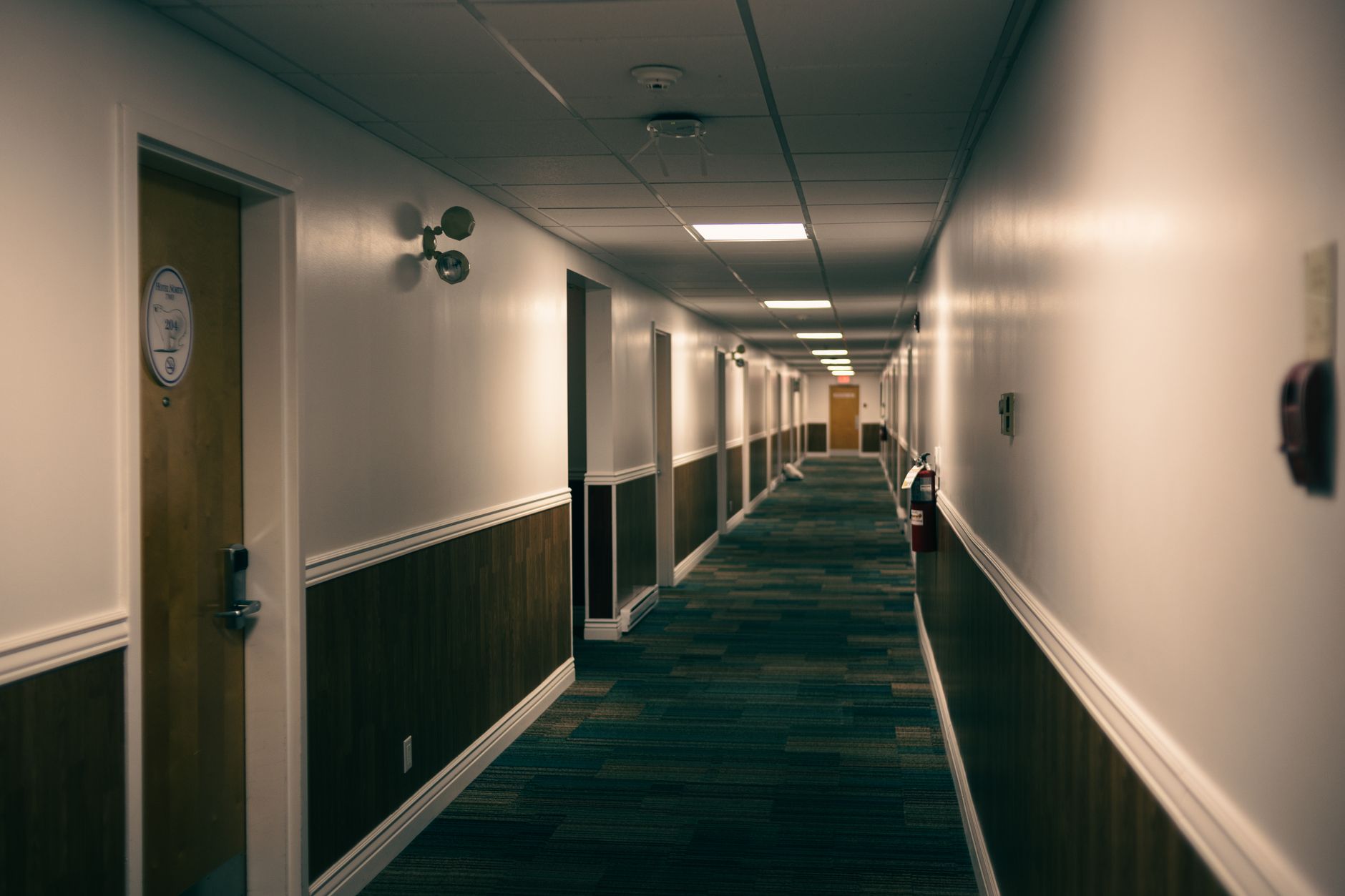
Stanley Kubrick's The Shining (1980) is a horror film that refuses to explain itself. Forty-six years after its release, it's still being argued over: what the hotel means, whether Jack Torrance was always going to break, what the photograph at the end is actually saying. That ambiguity isn't a flaw. It's the engine. The film doesn't frighten you once and send you home; it lodges in the back of the mind and keeps working.
What the film is actually about
Jack Torrance (Jack Nicholson) takes a winter caretaker job at the isolated Overlook Hotel in Colorado, bringing his wife Wendy (Shelley Duvall) and young son Danny (Danny Lloyd). Danny has "the shining," a psychic sensitivity that lets him see the hotel's violent past. Jack, a recovering alcoholic with a history of harming his own son, slowly unravels. That's the plot. The film is about something harder to name: the way a place can confirm what's already broken in a person.
Kubrick strips King's novel of most of its explicit supernatural machinery. The hedge animals that move on their own, the fire hose that becomes a serpent — gone. What replaces them is architecture. The Overlook is physically impossible. Corridors lead where they shouldn't. Room 237 sits in a position that can't exist given the hotel's exterior. The Steadicam follows Danny on his Big Wheel through carpeted hallways with the patience of something that has all the time in the world. The hotel feels wrong before anything supernatural happens, and that wrongness never resolves.
Jack Nicholson and Shelley Duvall
Nicholson's performance is the one everyone quotes, and rightly so. The axe through the bathroom door, the "Here's Johnny" — these moments are so embedded in pop culture that first-time viewers often underestimate the slower work Nicholson does in the film's first hour. Watch how he sits at his typewriter. Watch how he speaks to the bartender Lloyd (Joe Turkel) with the grateful ease of a man finding his people. The crack was already there. The Overlook just widens it.
Duvall's performance is harder to appreciate because Kubrick cast her to suffer visibly and convincingly, and he achieved that by making the shoot genuinely gruelling for her. What's on screen is real distress channelled into performance. Wendy is underwritten compared to Jack, but Duvall fills the gaps. Her terror in the final act is not movie terror. It's the full-body alarm of someone who has finally accepted that no help is coming.
Danny Lloyd, just six years old during filming, is astonishing in a way that's almost uncomfortable to watch. His conversations with his imaginary friend Tony, his face in the moment he sees the Grady twins in the corridor: the camera holds on him and doesn't cut away, and the film is better for it every time.
Kubrick's direction: what the camera is doing
The Steadicam work, choreographed by Kubrick and operator Garrett Brown, is now so widely imitated that it takes an effort to see it fresh. The tracking shots don't just follow characters; they pursue them with an interest that feels personal. When the camera follows Danny down the hallway on his tricycle, riding over carpet then hardwood then carpet in an audio rhythm that the film then cuts off with a hard visual shock, the effect is less jump scare and more dread made geometric.
Kubrick also uses symmetry as a threat. The Overlook's Gold Room, the long corridor leading to Room 237, the carpet patterns: everything is centred, balanced, and deeply unpleasant to look at for sustained periods. It's the opposite of how most horror films use visual space. There are no dark corners to hide monsters in. The fear lives in the open, in the middle of the frame, fully lit.
The score by Wendy Carlos and Rachel Elkind, alongside Kubrick's selection of pre-existing orchestral pieces by composers including Bartók and Penderecki, makes the sound design as disorienting as the images. Nothing resolves musically. Chords stack without landing. It's one of the most studied soundscapes in horror cinema, and it rewards headphones.
How it compares to King's novel
Stephen King famously disliked Kubrick's adaptation, and his objections are coherent: Kubrick removes the emotional arc that makes Jack Torrance a tragedy rather than a monster. In the novel, Jack's alcoholism and self-loathing are given real weight, and the hotel's possession of him is genuinely contested. In the film, Nicholson plays Jack as a man already near the edge in the opening scene, which King read as a misunderstanding of the character.
King's complaint is fair as a reading of his own book. But Kubrick wasn't making King's film. He was making a film about violence in domestic spaces, about the performance of sanity, about American mythology (the Overlook is built on a Native American burial ground, a detail the film notes once and then lets sit). The adaptation is a mistranslation that happens to be a masterpiece on its own terms.
For comparison, much the same friction between source material and adaptation shaped the reception of The Exorcist (1973), where William Friedkin's visual austerity diverged sharply from William Peter Blatty's theological richness. Both films survived the arguments between author and director. Both are better for the tension.
The ending and what it means
The final image: a photograph dated July 4th, 1921, showing Jack Torrance smiling at the centre of a Overlook ballroom crowd. It's been analysed as evidence of reincarnation, as a metaphor for American violence cycling endlessly, as a Kubrick joke. The film doesn't clarify. Jack froze to death in the hedge maze minutes before this image appears, so the photograph isn't documentation. It's a statement the film makes and then refuses to explain.
That refusal is exactly why The Shining remains a live object in 2026. Films that explain themselves exhaust themselves. This one doesn't. Watch it once and it's a frightening film about a man who loses his mind in a hotel. Watch it three times and the architecture starts to feel personally addressed to you.
Kubrick released The Shining through Warner Bros. in May 1980 to mixed reviews. The American critical establishment underrated it. Time corrected that. It's now the film by which other psychological horror movies measure their ambition, the same way its contemporary The Exorcist set the benchmark for supernatural dread seven years earlier. They occupy different rooms in the same house.
Verdict
The Shining (1980) is not a comfortable watch, and that's precisely the point. Kubrick builds a film that distrusts you back: it withholds resolution, plants visual contradictions, and scores everything with music that refuses to land. Jack Nicholson and Shelley Duvall give two of the most physically committed performances in the genre. The Overlook Hotel remains the most convincingly malevolent location in horror cinema. Watch it with the lights on. It won't help.
Rating: 10/10