In horror, the act of reading is never innocent. Almost every genre has a book somewhere in its architecture: a diary discovered in a locked room, a tome pulled from a forbidden shelf, a manuscript that shouldn't exist. What horror understands about books that other genres don't is that knowledge isn't neutral. Finding out is always the first transgression.
Why books work as horror objects
A gun, a knife, a monster: these are threats the body understands. A book is different. It operates through the mind. Horror films use this distinction deliberately, placing books at the intersection of curiosity and doom, so that the act of reading itself becomes the fateful gesture. You didn't go looking for the monster. You just wanted to know what was in the book.
The Necronomicon in Sam Raimi's The Evil Dead (1981) is the defining example. The characters don't summon evil on purpose. They find the book, they play the tape of someone reading it aloud, and that act of reception, of absorbing the words, is what tears the world open. Raimi understands that horror attaches not to intention but to contact. You don't have to mean it. You just have to read.
This is the book as a cursed object: deadly not because of what it is, but because of what it does to the reader. It's a logic horror shares with the cursed videotape in Ringu (1998). Both are media that contaminate through consumption. Both punish the act of paying attention.
The library as a space of dread
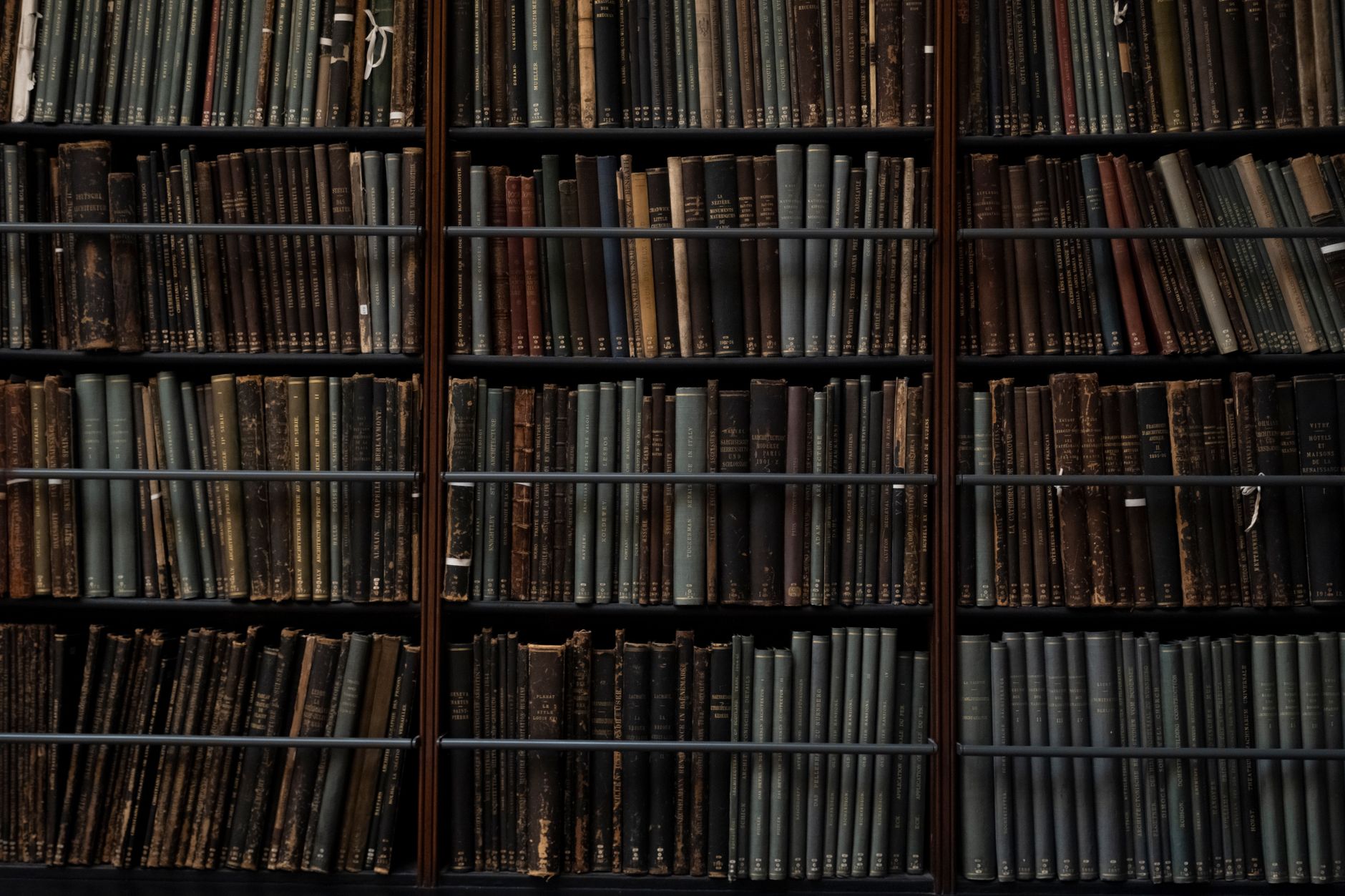
If the book is the weapon, the library is the arsenal. Horror films treat libraries not as places of learning but as repositories of things that should have stayed buried. They're usually dark, usually old, usually staffed by no one helpful. They're environments where the wrong information is always somehow findable, while the right information stays just out of reach.
The library in The Name of the Rose (1986) is a labyrinth of poisoned pages, where books kill literally: the reader licks a finger to turn the page and ingests the toxin on the paper. It's a medieval horror of bibliophile excess, a building full of forbidden texts guarded by murder. The library as maze, the book as trap.
What makes libraries work as horror spaces is their relationship to confined, enclosed architecture. The stacks press inward. There are no windows. The silence enforced by convention becomes oppressive rather than peaceful. You can't shout for help without violating the decorum of the space. Even the social rules of a library make it harder to escape.
Reading aloud: the moment the threshold breaks
Horror films treat silent reading as relatively safe. The moment a character reads aloud, something changes. Speaking the words makes them real in a way that private comprehension doesn't. This is ancient magical thinking, the idea that naming a thing summons it, and horror takes it seriously.
In Drag Me to Hell (2009), incantations spoken at the wrong moment carry consequences. In John Carpenter's In the Mouth of Madness (1994), the reading of Sutter Cane's novels doesn't just entertain: it reshapes the reader's reality. Carpenter takes the idea of a book with power over its audience and runs it to its logical extreme. The novel doesn't describe a world. It manifests one. The readers aren't passive. They're accomplices.
This is horror's sharpest use of the book: not as a haunted object but as a machine for producing believers. The text doesn't need to be supernatural itself. It just needs to be convincing enough to rearrange what the reader thinks is real. That's not so different from what any good novel does.
The protagonist who reads too much
Horror has a specific character type: the person who goes looking. The researcher, the academic, the amateur historian who pulls one thread and unravels something catastrophic. These characters are usually sympathetic precisely because curiosity is sympathetic. The audience would do the same thing. That's the point.
Peter Straub's protagonists tend to be writers or readers who stumble into the history of a place or a family and can't leave it alone. Sarah Waters builds The Little Stranger around a doctor who studies a crumbling house until the house starts studying him back. The reader-protagonist is both the narrative mechanism and the cautionary figure: someone whose intelligence makes the disaster possible.
What these characters share is that reading is their method of approaching the world. They believe that if they can gather enough information, they can understand and therefore control what frightens them. Horror disagrees. The genre's consistent position is that some things get worse the more you know, and the act of research is itself the provocation.
Marginalia and the book within the book
Some of horror's most effective uses of books involve what's written in the margins. The previous owner's annotations. The warning scratched in a flyleaf. The page ripped out and replaced with something wrong. Marginalia in a horror context implies that someone was here before you, that someone read this same book and felt compelled to leave a message, and that the message is something you don't want to read.
Mark Z. Danielewski's House of Leaves structures an entire novel around this principle: a manuscript annotated by someone who went mad studying it, those annotations then edited and supplemented by someone else who is also starting to unravel. The horror isn't the haunted house described in the text. It's the act of textual transmission itself, the idea that the book can carry whatever infected the previous reader into the next one.
This device shows up in films as the found diary, the journal of a previous occupant, the case file left behind by a predecessor. It's always a document that explains what happened to someone else and in explaining it begins to happen to you. The reader becomes the character. The genre collapses the distance between the story and the person receiving it.
What horror says about knowledge
Taken together, horror's use of books and reading constitutes a coherent argument about knowledge: that it has weight, that it transfers, and that some of it was hidden on purpose. The genre isn't anti-intellectual. Its protagonists are usually intelligent, curious people. But it insists that there's a difference between information and wisdom, and that acquiring the former without the latter is exactly how you let something in.
The book in horror is never just an object. It's a relationship between a text and a reader, and the horror lives in that gap: in what the text knows that the reader doesn't yet, in what the reader does with what the text tells them, in the irreversibility of having understood something you can't now un-understand.
Reading, in real life, is one of the safest things a person can do. Horror films use that safety as a setup. The act feels private, controlled, benign. Then the page turns and something that was contained in ink becomes real, and the room is different, and you can't put it back.