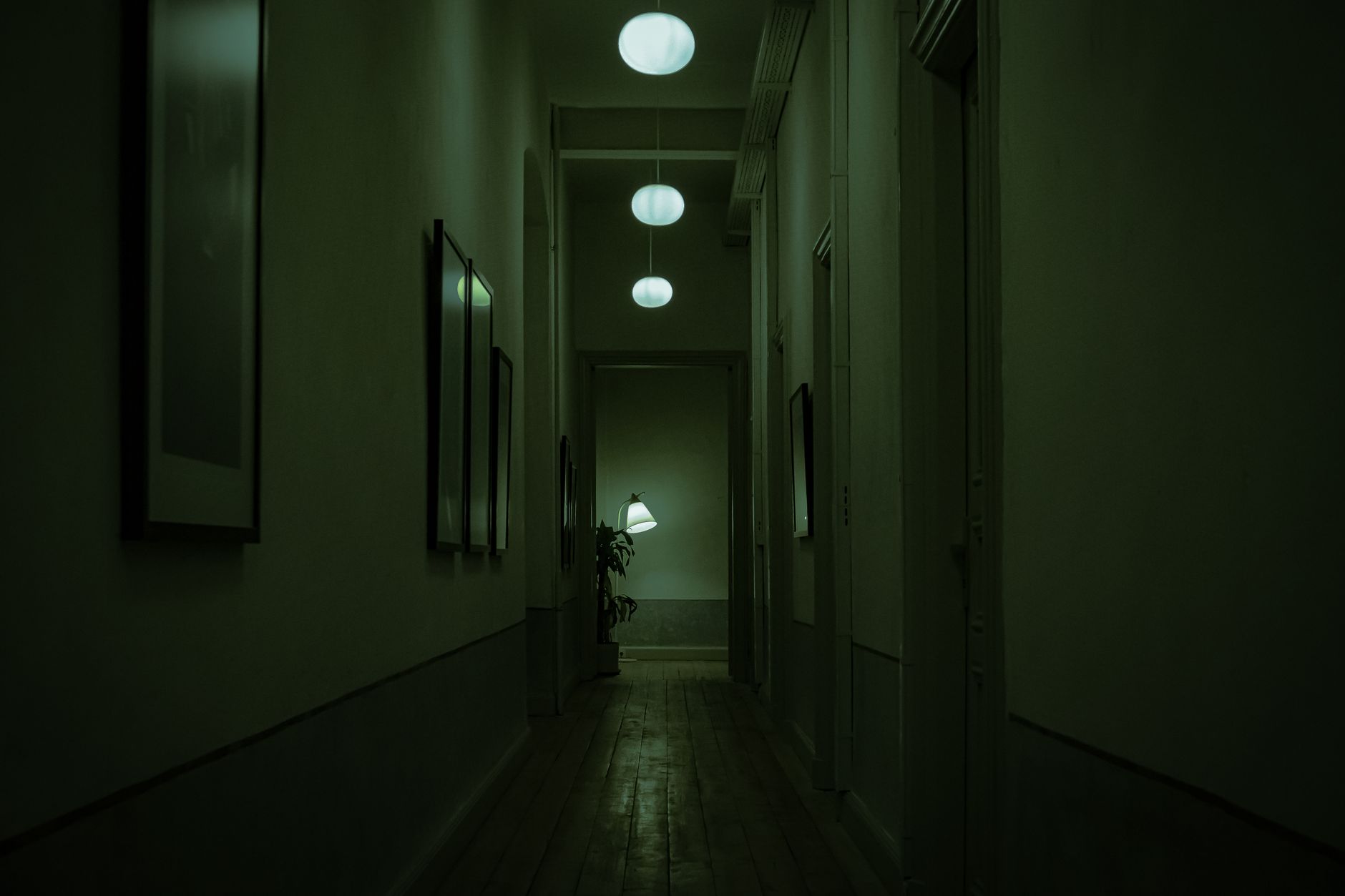
Horror has always known what architects discovered more slowly: a room can be a weapon. Long before the genre had special effects budgets or sound design as a craft, it was arranging walls. Narrow them. Lower the ceiling. Seal the door. Dread doesn't need a creature when it has geometry on its side. The confined space is one of horror's oldest and most reliable tools, and understanding how it works explains why certain films stay with you long after the monster is gone.
What a small space actually does to a viewer
Confinement creates two effects at once, and they work against each other in useful ways. The first is identification: when a character can't move, you share the paralysis. You sit in a cinema seat, which is itself a box, inside a dark room, and the screen shows you someone trapped in a smaller version of your current situation. The second effect is anticipation. In a large space, a threat can come from anywhere. In a small space, it can only come from one direction. Both of these facts are frightening, but in opposite ways, and the best confined-space horror plays both registers simultaneously.
The room or corridor doesn't just limit movement. It removes options. Horror is fundamentally about being without options. Every genre convention, from the car that won't start to the phone with no signal, is a variation on the same structural move: close off the exits, then introduce the threat. The confined space does this architecturally. It's the setup and the execution fused into a single location.
The corridor and the room: two different kinds of trap
Corridors and rooms behave differently as horror spaces. A corridor implies movement, direction, destination. It suggests that somewhere beyond the frame there is relief. That promise is what makes it cruel: a corridor always offers the possibility of escape while denying it in practice. You can see the door at the end. It doesn't open. The corridor in The Shining (1980) is the definitive example of this. Kubrick's Overlook Hotel corridors are too long, too symmetrical, and too empty to feel like a place designed for human movement. They're a maze dressed as a hotel, and the geometry tells you this before anything supernatural appears.
A room, by contrast, removes even the illusion of direction. Session 9 (2001) uses the rooms of Danvers State Hospital the way a cage uses bars: not to prevent movement exactly, but to make every movement provisional. The characters can walk from room to room, but the building redistributes them according to its own logic. That's the more insidious architectural horror. The space permits motion while making motion meaningless.
Water and other invisible walls
Confinement doesn't have to be solid. Some of horror's most effective spatial traps are made of fog, darkness, or water. The Descent (2005) uses cave tunnels that are barely wider than a human body, and director Neil Marshall shoots them in a way that makes the rock feel like it's pressing in from both sides simultaneously. The characters can move, technically. But moving means scraping against stone on every surface. The tunnel isn't just a location. It's a sensation transferred to the audience through framing and sound.
What The Descent understands is that the tightest confinement isn't always the most visible. A character standing in a featureless black room is confined, but the darkness hides the walls. A character wedged in a flooded cave passage can see and feel every inch of what's trapping them. The second is worse. Visible confinement is more frightening than abstract confinement, because the brain can't soften what the eye can measure.
The psychological room
There is a version of confined-space horror where the walls are internal. The character isn't in a small physical space but in a perception that has contracted. Repulsion (1965) is the central example. Roman Polanski filmed a Kensington bedsit expanding and contracting according to Catherine Deneuve's deteriorating mind, with cracks spreading across walls that should be solid. The space isn't literally shrinking. But the film makes you experience it as though it is. The room becomes a projection of a psyche with no exit.
This is what separates horror's use of confinement from thriller's use of the same device. A thriller uses a small space to create urgency: the countdown, the limited ammunition, the locked door. Horror uses a small space to create inevitability. There's no countdown in a psychological horror space. The compression isn't temporary. It's what the room is.
Why the box works: structure and symbol
At its most abstract, a confined horror space is a coffin. The genre has always known this. The coffin is the extreme end of spatial reduction: a human body in a wooden box exactly its size. Horror keeps returning to coffin logic because it's the universal fear. Not just of death, but of the body's dimensions being the only dimensions remaining. Cube (1997) mechanised this insight, placing six strangers in a grid of rooms where each room is the same size and the rules change with no warning. The cube of the title isn't just the physical structure. It's what happens to your sense of the possible when the space is reduced to identical repeating units with no outside.
The unreliable narrator in horror often works through a similar compression: not of physical space but of epistemological space. In both cases, the trap is structural. You're not being deceived by a person or hunted by a monster. You're being contained by a system with its own rules, and escape requires understanding those rules before they kill you. Both kinds of horror ask the same question: what do you do when the thing containing you has no outside?
Finding a room that breathes
The best confined-space horror eventually does something unexpected: it gives the space breath. A room that never changes is predictable, and predictability kills dread. The effective confined space expands and contracts. It reveals new corners. It turns out to be larger than it appeared, or smaller. The haunted hotel room in countless films of the genre works because rooms have a psychology: a wardrobe you haven't opened, a bathroom door slightly ajar, a window that faces another window. The room already contains its own horror before anything arrives, because a room is a space someone lived in and left.
That residue is the final element of confined horror that separates it from simple claustrophobia. It isn't just that the space is small. It's that the space was once inhabited, and whatever inhabited it is still somehow present. The walls absorbed it. The most frightening rooms in horror aren't empty. They're recently vacated. Something was here. It went nowhere you can see. That's not relief. That's worse.