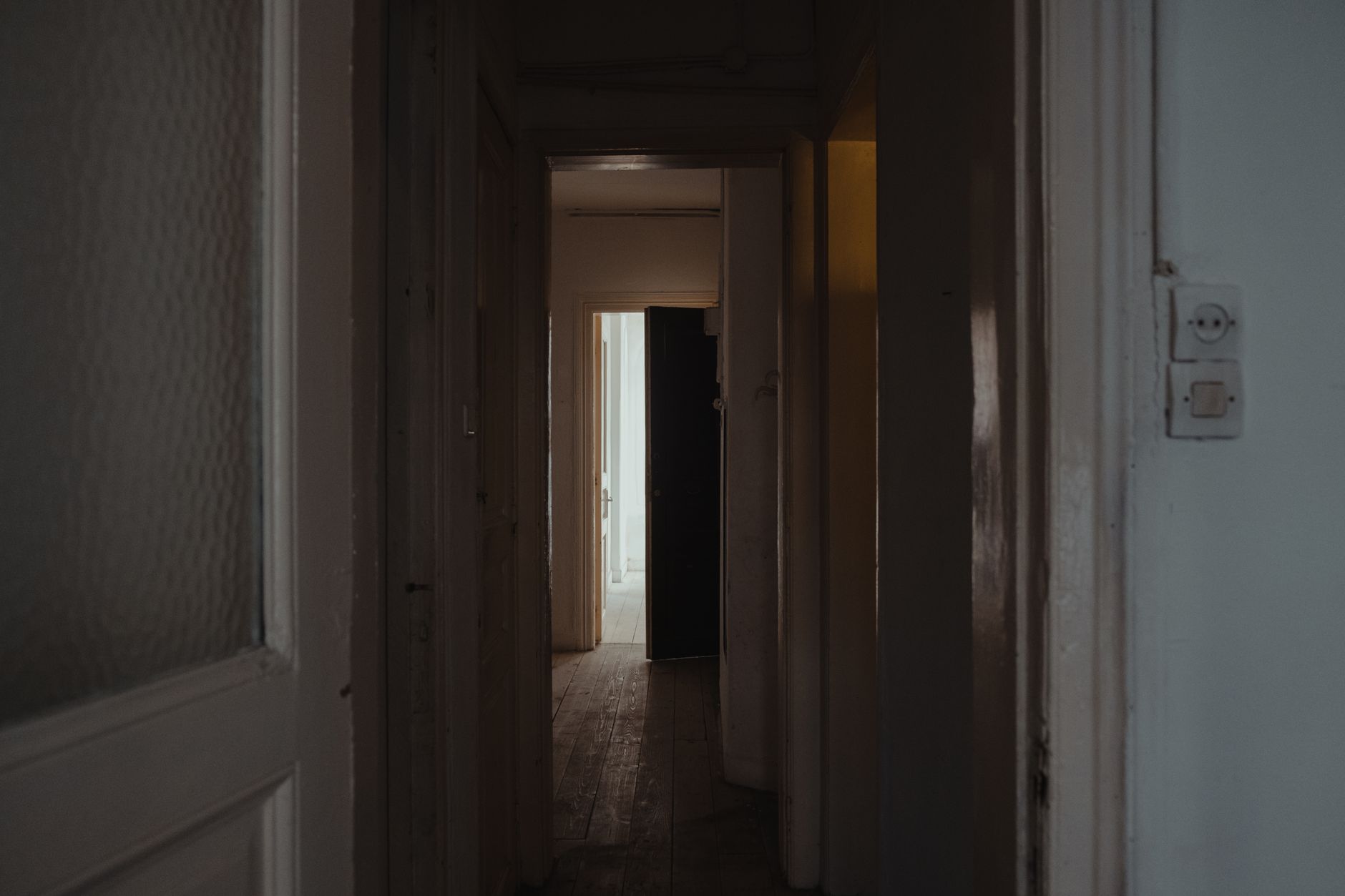
Horror has always needed a threshold. Before the monster arrives, before the score tilts into dissonance, before anything moves at all, there is a door. It stands between the character and whatever the film has decided to put on the other side. That interval, the moment before the handle turns, is where much of horror's real work gets done. The door isn't scenery. It's the genre's most precisely calibrated object.
What a door actually does in a horror film
A door does one thing structurally: it divides space. Inside and outside. Known and unknown. Safe and not. Horror builds its entire emotional architecture on that division, which makes the door not just useful but fundamental. It's the physical expression of a question the genre never stops asking: what's on the other side?
The key word is "physical." Horror needs to materialise its dread. The monster you never see works precisely because the imagination fills the gap, but imagination needs an anchor. A door provides one. It says: something is here, now, pressing against this boundary. The viewer's mind does the rest.
This is why a closed door is often more frightening than an open one. When a door opens in a horror film, the film makes a choice about what to reveal. When it stays closed, the film delegates that choice to you. That delegation is a form of control. The director keeps you at the threshold indefinitely, and the longer you wait, the worse whatever's behind it becomes.
Knock, don't come in: the etiquette of horror doors
Horror films understand social rituals around doors better than almost any other genre. Knocking carries a specific weight. In When a Stranger Calls (1979), the terror isn't a knock at the door but a call from inside the house, which works because it inverts the door's basic grammar. The threat isn't outside. It's already in. The door has already failed.
That failure is crucial. A door that cannot hold transforms the space inside it. The home stops being a refuge and becomes a trap. Horror uses this inversion constantly, but the films that do it best take their time getting there. They let you believe the door works before proving it doesn't.
The locked door is a variation on this. The Shining (1980) gives us the bathroom door in Room 237: locked from the inside, which shouldn't be possible, which means the inside is already compromised. Jack Torrance unlocks it. What he finds is Kubrick's most controlled scare. The locked door promises safety. The unlocking of it promises nothing good.
The door as a character's choice
Horror audiences shout at screens. "Don't open it." "Don't go in there." This is not stupidity on the audience's part. It's an acknowledgment that the door represents a decision point, that the character is about to choose to cross a threshold they can't uncross. The door externalises the moment of no return.
This is what distinguishes the door from other horror settings. The confined space traps a character involuntarily. The door asks for consent, and horror's cruellest trick is making characters give it freely. They open the door. They walk through. The genre watches them do it and says nothing.
In Hereditary (2018), doors frame the film's most unbearable images precisely because a character's agency is involved at every stage. Things happen on the other side of doors that the camera refuses to follow. Then it cuts, and you understand what it didn't show you. The door becomes a cut point, a place where the film decides how much damage to do.
Domestic doors versus institutional ones
Not all horror doors carry the same meaning. The front door of a family home carries a different weight than the iron door of a facility. Horror's use of domestic space depends on the home door being a promise of protection, specifically so the genre can break that promise. When something knocks on a front door after midnight in a horror film, the dread is proportional to how much safety that door was supposed to represent.
Institutional doors work differently. The doors of an asylum, a hospital, a prison: these promise containment rather than protection. The terror in those spaces comes from the wrong thing being contained. Session 9 (2001) uses the corridors and sealed rooms of the Danvers State Hospital to build dread from accumulated closure. Each door that opens in that film reveals a room that isn't empty of history. The building remembers. The doors are the seams.
Hotel doors occupy a third register. A hotel door is both domestic and institutional. It promises temporary safety in an anonymous building, which is almost no promise at all. In The Shining, every room door along that corridor is a question mark. The hotel has 237 of them. It only needs one to be wrong.
The door that opens by itself
Few images in horror are more reliable than the door that moves without a hand on it. A slow creak. A widening gap. Nothing visible through the gap. This image works because it separates cause from effect. Something is acting on that door, but the camera won't confirm what. The result is the same mechanism that makes the unseen monster so effective: your imagination produces something specific, personal, and tailored to your worst possibilities.
What's notable is how little horror films need to do beyond the movement itself. No music. No visible presence. Just a door moving in a room that should be still. That's enough. It's been enough since the genre learned to do it, and it hasn't stopped working.
The self-opening door also signals a loss of the character's environmental control. If doors open without being touched, the physics of safety no longer apply. The domestic world has been reclassified. This is the threshold crossed before the visible threat arrives: not a physical door, but an epistemological one. The character, and the viewer, now live in a world where doors can't be trusted. That's the real horror. The door was just the announcement.
Argento and the door as pure geometry
Dario Argento treats doors as compositional elements before he treats them as narrative ones. In Suspiria (1977), doorways frame bodies. Characters appear in them, and the frame within the frame is a visual amplifier, drawing the eye and isolating the figure in space. When something wrong happens in an Argento film, it frequently happens in or through a door. The geometry of the threshold becomes the geometry of violence.
Tenebre (1982) is colder and more architectural still. Its murders happen across the lines of domestic interiors, and the doors in that film function as boundaries between the film's public and private registers. The killer uses doors as a detective uses them: as points of entry and exit, as evidence, as the shape left in a space by someone who passed through it. The door is never innocent in Argento. It's always been touched by something.
What the door leaves unresolved
Horror's most honest films don't resolve the door. They leave it open, or ajar, or simply standing there after the credits roll, a persistent reminder that the threshold wasn't sealed. The genre's deepest discomfort isn't what's on the other side. It's the fact that there is an other side at all, that the world is divided this way, that something always lives beyond the boundary of the known.
A door that closes at the end of a horror film is a provisional comfort. It holds for now. It held before, too, and you remember how that went.