The haunted hotel is one of horror's most reliable machines. It looks like a house, functions like a community, and behaves like a trap. You can walk in voluntarily, pay money to be there, and still find no way out. That contradiction is what the genre has been feeding on for decades. The haunted house gives you a family and a history. The hotel gives you a stranger in the next room and a locked minibar.
What the hotel does that the house can't
Haunted houses work through inheritance. The family is bound to the property by blood, debt, or guilt. They can't leave because leaving means admitting defeat, or abandoning someone, or losing everything they've built. The stakes are domestic. The horror of The Shining (1980) is partly Kubrick exploiting precisely that expectation: the Overlook Hotel is Jack Torrance's job, his chance, his last shot. He chose to come. He's being paid. The building turns that professional obligation into something far more sinister than a family home ever could.
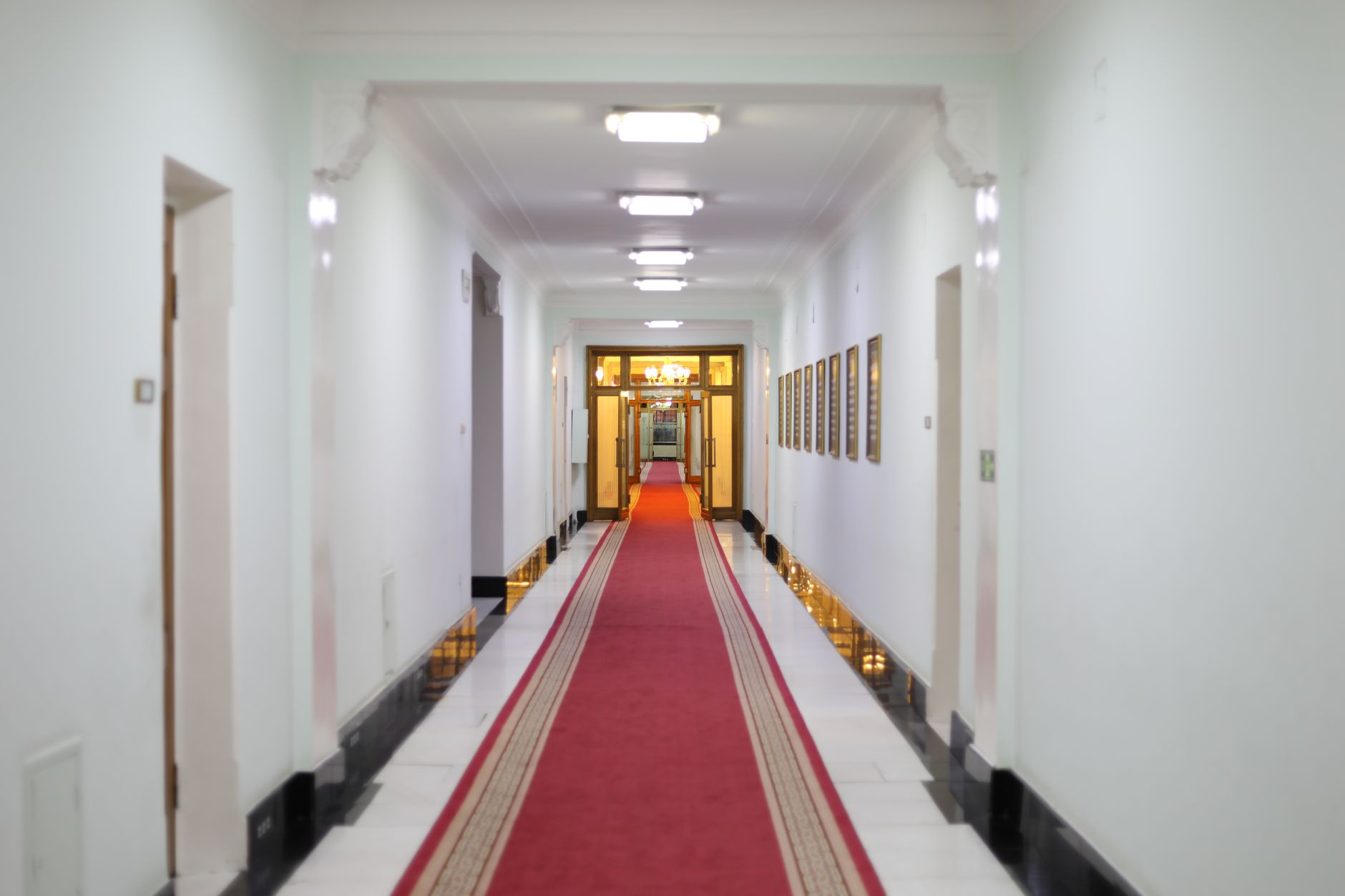
A hotel also carries an inherent democracy of dread. Everyone in a haunted house has a name, a relationship, a reason to be afraid of something specific. A hotel stuffs the building with people who don't know each other, don't share histories, and have no reason to trust anyone. That anonymity is itself frightening. You're surrounded by strangers in identical corridors. The carpet is the same on every floor. Nothing in the architecture helps you work out where you are.
The geometry of the grand hotel
The physical structure of the old grand hotel matters enormously. It's designed to be both overwhelming and repetitive: enormous public spaces that dwarf the individual, and then miles of identical corridors leading to identical rooms. This twin quality, vastness and sameness, is disorienting in real life and lethal in horror. It means the monster (or the madness, or the grief) can appear anywhere. There's no safe room that differs architecturally from the dangerous ones.
Kubrick understood this. The Overlook's hedge maze has its twin inside the hotel itself: corridors that don't lead where they should, a floor plan that violates Euclidean space. Rooms appear that shouldn't exist. The geometry lies. Once you accept that the building's layout is unreliable, you've accepted that nowhere is safe, which is exactly what the film needs you to feel before it puts Danny Torrance on a tricycle.
Stanley Kubrick's film aside, the hotel setting reappears in films that take very different approaches to the same core problem: Mike Flanagan's work, Scott Derrickson's adaptation of Stephen King's 1408 (2007), and a dozen European genre films use the same architecture for completely different purposes. The room becomes a confessional. The corridor becomes a timeline. The lobby becomes a stage.
Isolation without wilderness
Remote horror settings traditionally use landscape to enforce isolation. A cabin in the woods, a farmhouse at the end of a dirt road. The hotel reverses this logic. It places the horror in a building full of other people, and the isolation is still total. The guests in adjacent rooms become useless. The concierge is part of the system. The phone connects to the front desk, not the outside world. You're surrounded by infrastructure and completely alone.
This urban or semi-urban isolation is qualitatively different from wilderness isolation. In the woods, the threat is external: something out there, in the dark, beyond the treeline. In the hotel, the threat is already inside with you. It lives in the walls, in the ventilation, in the room directly above yours. It has a key.
That interiority links the haunted hotel to a whole tradition of psychological horror. The building becomes a skull. What's in it is what the character brought. The Haunting (1963) does this with a house, but the logic applies with even more force to a hotel, because the hotel has no history with you specifically. Whatever it reflects back is yours alone, not a family inheritance. The horror is more intimate for being less explicable.
Guests, staff, and the corrupted service economy
One of the genre's sharpest tools is the hotel's service structure. Hotels run on a specific social contract: staff serve guests, guests pay and are cared for, everyone performs a role. Horror breaks this contract and then uses the broken pieces. The concierge who knows too much. The bellhop who's been working there since 1921. The manager who smiles at checkout when you've just witnessed something catastrophic.
This corruption of the service economy taps into a real, low-level anxiety most people carry into hotels. You're sleeping in a room that hundreds of others have slept in. Someone else holds the master key. The staff know the building better than you do. In ordinary circumstances, that familiarity is reassuring. In horror, it becomes threatening. The person who knows where everything is becomes the person who knows where to put you.
It also allows for a specific kind of gaslighting. The hotel professional who insists nothing is wrong, who attributes disturbances to the plumbing or another guest, who offers a room change with a smile, performs their normalising function so well that the protagonist doubts themselves. The institution becomes complicit. This is the move 1408 makes early: John Cusack's character is warned not to enter the room by a manager who seems genuinely afraid. The warning is real, but it's also the first step in a process that isolates him completely from anyone who might help.
Why writers keep returning to it
Stephen King has returned to the hotel setting more than once, and not only because the Overlook made him famous. The hotel is a machine for generating the specific kind of dread he's always found most interesting: the fear that ordinary life is thinner than it looks. A family man takes a caretaking job. A writer checks into a room to work. These are unremarkable decisions. The horror in King's work almost always starts from the most reasonable choice a reasonable person could make. The hotel enables this because going to a hotel is a normal thing people do. There's no gothic warning built into the premise. No previous tenant left a warning carved into the wall. You simply arrived, and now something has begun.
That ordinariness is the hotel's most powerful quality. It's not a ruin, not an asylum, not a Victorian pile at the end of a lane. It's a place with a TripAdvisor rating and a continental breakfast. Horror that starts from that baseline has to work harder to earn its dread, and when it does, the effect is sharper. The familiar turns hostile. The corridor you walked down to get ice at midnight now reads completely differently. You walked it once without fear. That's what it took from you.
Horror films that use the hotel as a setting are also, almost always, doing something with time. Hotels are places people pass through, which means they accumulate histories that don't belong to their current occupants. A room has been slept in by thousands. The bed has absorbed decades of dreams, arguments, grief, celebration. The hotel is simultaneously a building and a record. When horror accesses that record, it turns the guest into an archaeologist who didn't know they were digging.
The sound design of these sequences matters enormously: the mechanical creaks, the ice maker down the hall, the elevator cable's groan. As discussed in the sound design of horror, these ambient architectural sounds become the building's voice. In a hotel, where those sounds are unfamiliar and slightly wrong, every noise reads as a communication from somewhere you can't see.
The room as the real protagonist
In the best haunted hotel films, the room matters more than the guest. Room 237. Room 1408. These numbers become entities. The room has a personality, a history, an agenda. The human is just the latest person it's working on. This inversion is what separates the genre's best hotel horrors from lesser examples: when the building has more interiority than the characters, the characters become terrifyingly small.
That smallness is the point. You checked in thinking you were a person. The hotel has reminded you that you're a guest.