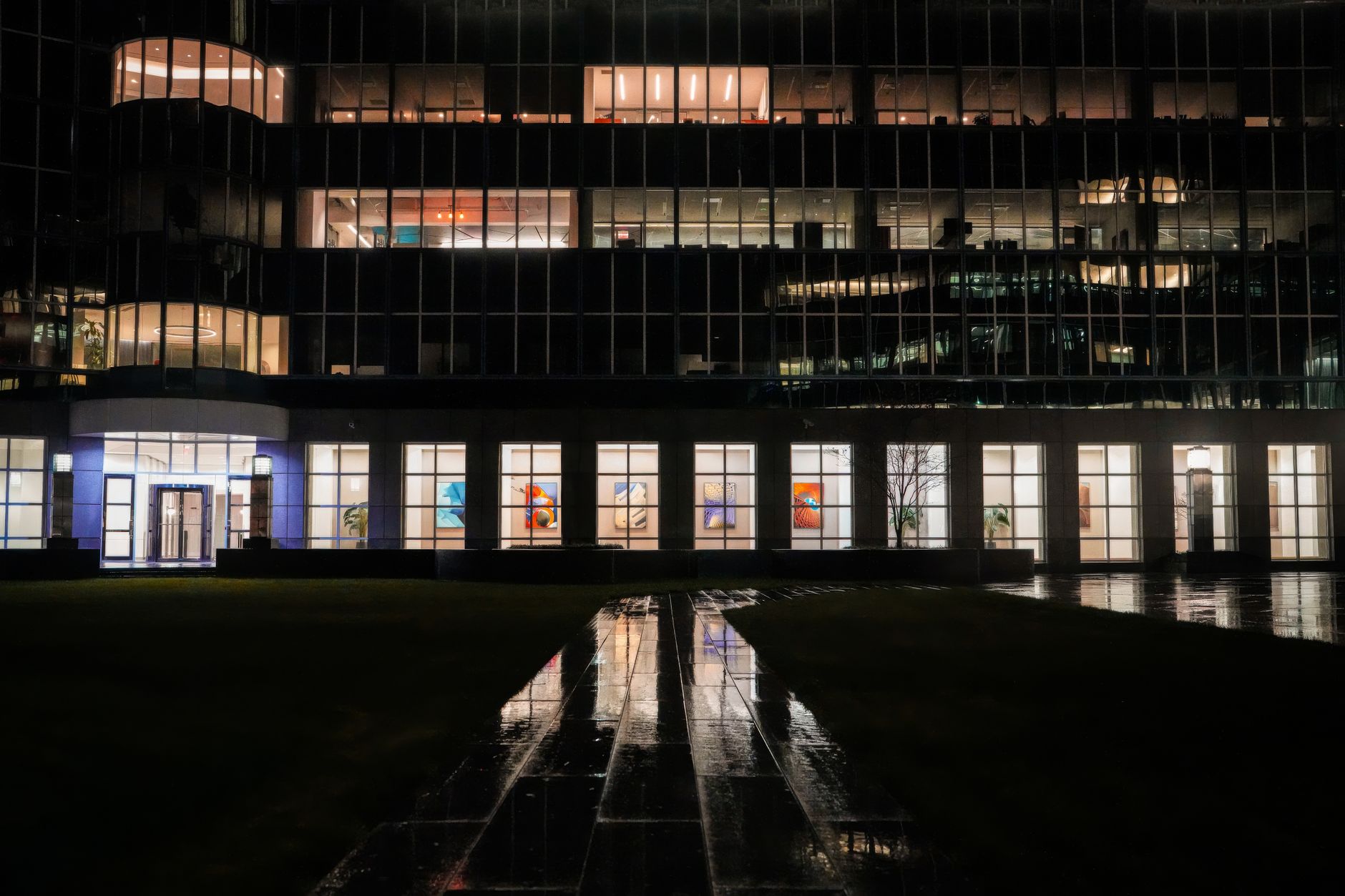
Horror has always fed on the spaces where power is unequal and exits are few. The office, the factory floor, the open-plan workspace: these are environments built on compliance, hierarchy, and the quiet understanding that you can't simply leave. That's the same architecture the genre uses in its hospitals and schools. But the workplace adds one element the other institutional spaces don't always carry: the horror of choosing to be there, every single day, because the alternative is worse.
What makes the workplace so useful to horror isn't violence. It's the slow grind. The genre understands that prolonged, low-level coercion is its own kind of dread.
The institution that never closes
A haunted house lets you leave in the morning. An office traps you on a schedule. The working day imposes a rhythm: arrive, perform, comply, repeat. Horror films set in workplaces use that rhythm as a ratchet. Each loop tightens. The dread accumulates not in a single confrontation but across the accumulation of ordinary requests, odd demands, and small surrenders that feel reasonable until, suddenly, they don't.
This is the same logic that runs through horror's use of hospitals: the institution's protocols outlast any individual's comfort or conscience. In the hospital, the patient submits to procedures. In the office, the employee submits to process. Both environments are built on the idea that the system knows best, and both become monstrous when that idea is correct in the worst possible way.
The key difference is consent. Patients rarely choose their hospital stay. Workers, technically, choose to clock in. That choice is what the horror of the workplace exploits: the gap between the freedom you nominally have and the freedom you can actually exercise.
Hierarchy as the monster's skeleton
The best workplace horror doesn't need a supernatural entity. It needs a manager. The boss who watches too closely, the HR department that handles everything and nothing, the colleague who reports back: these figures carry authority without accountability, and that combination is the genre's favourite chassis for dread.
Peter Weir's The Plumber (1979) works almost entirely on this principle. A man enters a woman's flat, ostensibly to fix the pipes, and the film turns the power of professional legitimacy into something genuinely suffocating. He belongs there, technically. That belonging is exactly what makes him impossible to remove. The workplace horror film inherits this logic directly: the person with authority belongs in the building, so their presence can't be refused, only endured.
Michael Haneke understood this too. His television film Benny's Video (1992) is partly about the bureaucratic impenetrability of a family system, but the same mechanism operates in full institutional horror: the authority figure doesn't have to threaten you. It just has to be there, exercising its legitimate function, while the walls close in.
The open plan as panopticon
Horror loves enclosed spaces, but the open-plan office is a different kind of trap. There are no walls to press against. Every desk is visible from every other desk. The horror isn't confinement: it's total exposure. You can't hide. You can't react. You have to perform normality while something is wrong, because forty people are watching.
This is precisely the kind of pressure that horror's authority figures exploit best. The boss, the supervisor, the team leader: each one operates most effectively in an open space where disobedience is immediately visible. The floor plan itself enforces compliance. The horror of the workplace is that the architecture has already done half the monster's work before anyone arrives.
The Belko Experiment (2016), written by James Gunn and directed by Greg McLean, makes this explicit by locking an open-plan South American office building and announcing that employees must kill each other or face greater consequences. The film is blunt, but its insight is real: strip away the social contract of the workplace and what remains is a structure already optimised for control, already sorted by rank, already telling you whose life matters more. The building didn't have to change. The people did.
The job that asks too much
Some workplace horror focuses not on the building but on the nature of the work itself. What if the job requires you to become something you don't want to be? This is the tension that drives Starry Eyes (2014), which uses the entertainment industry's audition process as a vehicle for body horror. The protagonist doesn't just want the role. She wants it badly enough to let it eat her from the inside. The film understands that the most effective corporate horror isn't coercion: it's desire. The institution doesn't have to force you. It just has to offer something you can't refuse.
The same mechanism operates in the devouring logic of Hollywood as horror: the industry functions as a sacrificial system, and the sacrifice is entirely voluntary, right up until it isn't. That's the purest form of workplace dread. The exit was always there. You just kept not taking it.
Night shifts and the empty building
Horror set in workplaces after hours exploits a different fear. The office at night is a different space entirely. The cleaning crew, the security guard, the employee who stayed too late: these figures move through rooms designed for forty people, now empty. The furniture remains. The desk, the chair, the humming server room. The function is gone. What's left is pure form, and pure form, the genre understands, is where the uncanny lives.
Session 9 (2001) is technically set in an asbestos-removal job at a decommissioned psychiatric hospital, but it works as workplace horror precisely because it treats the job itself as the vector of contamination. The men go in every day. They follow a schedule. They have a deadline. The professional framework is what keeps them returning to the building that's destroying them, one shift at a time.
The night-shift horror of an empty office block follows the same pattern. The person doing legitimate work in a space that should be empty is a figure the genre has used repeatedly, in Demons 2 (1986), in the television segments of Ringu (1998), and in the security-camera aesthetic that found its fullest expression in the Paranormal Activity franchise. The job gives you a reason to stay. The horror gives you a reason to leave. The tension between the two is the film.
What the workplace horror film is really about
The office, the factory, the warehouse: these are spaces built on the premise that your time isn't entirely your own. You've traded it for income, for security, for status. That trade is ordinary. It's also, if you look at it sideways, a profound vulnerability. The horror film looks at it sideways.
What the genre finds there is a form of coercion so normalised it barely registers as coercion at all. You come in. You do what's asked. You don't ask certain questions. You let certain things go. The workplace horror film asks what happens when the things you're letting go are genuinely monstrous, and the answer it keeps arriving at is: you keep showing up anyway, because the structure makes leaving feel impossible, even when it isn't.
The monster at the desk doesn't need fangs. It needs a performance review.