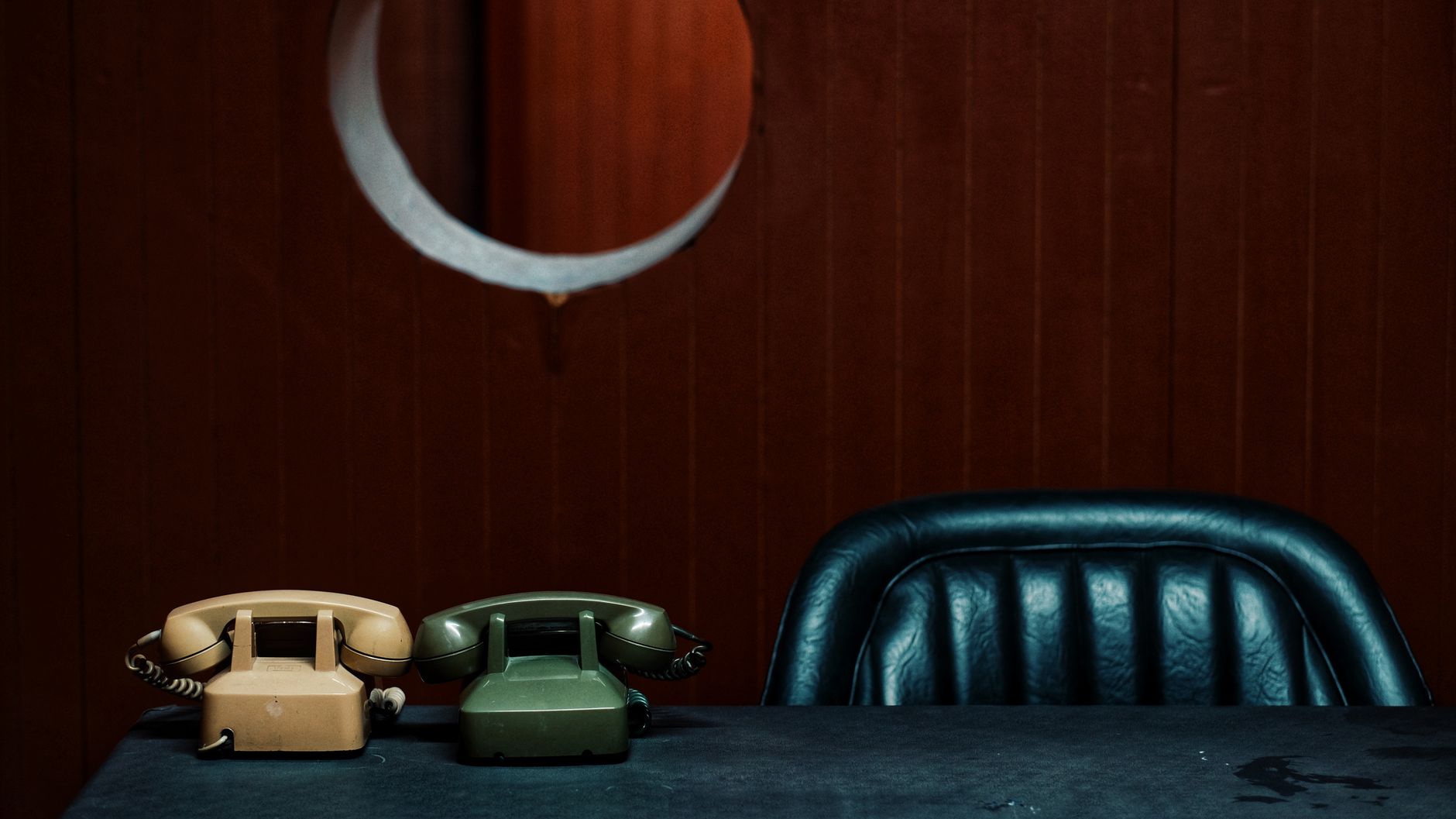
The telephone arrives in horror as a promise. You pick it up and something on the other end knows your name. It knows where you are. The horror of the phone isn't the caller, it's the fact that you answered. Every time a character in a horror film lifts a receiver, the film makes a silent point: the line between safety and catastrophe was never as reliable as you assumed. The telephone is horror's most intimate technology, because it admits something you didn't invite directly into your ear.
Why the phone works where other technology doesn't
Horror has used radios, televisions, and computers as conduits for the supernatural. All of them work at a remove. The screen is across the room. The speakers broadcast. But a telephone demands physical contact. You press the receiver to your skull. The voice enters through the same canal as whispered secrets and childhood lullabies. That intimacy is the phone's specific horror utility, and the genre has never stopped exploiting it.
The 1979 film When a Stranger Calls is the purest expression of this idea. Its opening act is almost nothing but telephone calls: a babysitter alone in a house, a ringing phone, a breathing voice. The film's famous twist, that the calls are coming from inside the house, is devastating precisely because it weaponises the assumption of distance that the phone implies. You call for help; help is what can't reach you. The receiver becomes a prop in someone else's ritual.
What makes the telephone different from other horror objects is its bidirectionality. A locked door keeps things out or in. A mirror reflects. But a phone connects. When a character picks one up, the monster already has the other end. The horror isn't the technology malfunctioning. It's the technology working exactly as intended.
The ringing phone as a formal horror beat
Horror directors treat the ringing telephone the way composers treat a held note: it's tension with a built-in release. The ring demands a response. You can ignore it, but that's its own kind of dread. You can answer, but then you've handed something the opening it wanted. Ringu (1998) structures its entire dread mechanism around this logic. The cursed videotape ends and the phone rings. The ring is the confirmation. The seven days begin with a sound, not an image, and Hideo Nakata understood that an auditory threat cuts deeper than a visual one because you can close your eyes.
The phone in Ringu is also a marker of modernity pressed against something ancient. The curse predates electricity. The spirit of Sadako doesn't need wires. She uses the telephone because the audience does, because it normalises the contact before making it fatal. This is a technique horror films return to whenever they need the audience to feel the horror in their own lives: recruit the technology they already trust.
Voices that shouldn't have a number
When the phone call comes from somewhere impossible, the horror shifts from suspense to something closer to cosmic unease. Black Christmas (1974) built its entire architecture on this premise. The killer's calls to the sorority house are recordings of overlapping voices, childlike and guttural and inhuman, and the film's most disturbing revelation is that the police can't trace them because the technology doesn't have a category for where the calls originate. The slasher formula Black Christmas pioneered put the caller inside the building, but the voice itself remained somewhere else entirely.
This is the deeper dread the telephone unlocks: not just proximity, but categorical wrongness. The voice on the line shouldn't exist. It belongs to someone dead, or to something that never lived, or to a version of the caller that hasn't happened yet. When the phone rings in a horror film and the character answers, they're often receiving information from outside the frame of normal causality. The phone doesn't just carry a threat. It carries proof that the world the character assumed they were living in was always wrong.
The helpline call that goes nowhere
Horror also uses the failed phone call. The character who dials for help and can't get through, whose signal drops, whose landline has been cut, whose call connects to something that isn't the police. This failure is a specific sub-genre of telephone horror: the moment the safety net proves imaginary.
It's worth separating this from simple bad luck. When a horror film cuts a phone line, it's making a statement about institutional protection. Help was always contingent. The telephone represented a promise society couldn't keep. This is why so many rural and isolated horror settings sever communication first. The cut line isn't a plot convenience; it's the film's thesis arriving early.
Pontypool (2008) inverts this neatly. In that film, the radio station becomes horror's container, and communication itself is the vector of contagion. The telephone calls from the outside world bring information that makes things worse. Each new call narrows the characters' options. The phone is still the instrument of dread, but here it's not the caller who's the threat. It's the act of receiving information at all. Knowing too much, through whatever channel, is fatal.
The phone as evidence of obsession
Horror also uses the telephone as a tracker of psychological deterioration. The character who keeps calling a disconnected number. The character who can't stop redialling. The phone that rings in an empty house when the protagonist is certain no one has the number.
This mode of telephone horror is closely tied to grief. The dead don't stay dead in horror films, and nothing marks their return more economically than a ringing telephone. A dead spouse's number appearing on a caller ID, a child's voice on a line you know hasn't been used since the funeral: the phone collapses time. It refuses to let the living move on. This is grief weaponised, the horror of love refusing to accept its own ending.
What the telephone does in all of these modes is the same thing. It makes distance meaningless. The locked door, the drawn curtain, the security chain: all of it falls away when something has your number and decides to use it. Horror understands that the most frightening phone call isn't the one you don't answer. It's the one where you pick up and hear your own voice saying something you haven't said yet.
Sound design and the telephone
The formal power of the telephone in horror is partly a question of sound design. A phone ring in a silent scene is one of the most viscerally startling sounds available to a director. It's culturally conditioned: decades of pavlovian response to that sound have made audiences jump at it even when they know the film is coming for them.
Beyond the ring, the voice itself changes over a phone line. Compression artifacts, faint static, the slight delay of a bad connection: all of these transform a human voice into something slightly inhuman. Directors exploit this. A villain sounds more threatening on a scratchy line. A ghost sounds more convincing. The telephone's acoustic imperfection is a gift to the genre, because it erodes confidence in what you're actually hearing.
The great horror sound designers know that the scariest moment isn't when the monster speaks. It's the three seconds of ambient noise before it does. Breathing. Static. A faint sound that might be wind or might be something else entirely. The telephone gives directors a formal container for exactly that pause, and the best of them make those seconds last forever.
Horror keeps returning to the telephone not because it's novel but because it isn't. It's everywhere. It's in every pocket. It rings at night. And every time it does, the genre has already planted the idea that you might not want to know who's calling.