Mandy (2018) is the film that turns a dead woman into a cosmology. Panos Cosmatos sets the entire picture in 1983, deep inside a Pacific Northwest that never existed outside of heavy-metal album covers, and uses that invented landscape to build a revenge horror so saturated and so loud that it stops feeling like a genre film somewhere around the forty-minute mark and starts feeling like a wound. It stars Nicolas Cage. That's not incidental. The film needs him specifically, and it knows it.
What Cosmatos is actually doing
The plot is a sentence: Red Miller (Cage) and Mandy (Andrea Riseborough) live in the woods. A cult leader named Jeremiah Sand (Linus Roache) sees Mandy from a passing van, wants her, and sends a biker gang of demonic creatures to take her. Red watches her die. Red builds a chainsaw and goes to find everyone responsible. That's the spine. Around it, Cosmatos builds something closer to a tone poem than a thriller, structured in two distinct halves that feel like different films sharing a heartbeat.
The first half is slow and achingly tender. Cosmatos films Riseborough and Cage in their cabin with the patience of a painter. She reads a fantasy novel. He sits with a beer. They talk the way people talk when they feel completely safe. Jóhann Jóhannsson's score (his final feature before his death in 2018) saturates these scenes in warm drone and strings, making them feel beautiful and already elegiac. Cosmatos is building something to destroy. He's deliberate about it.
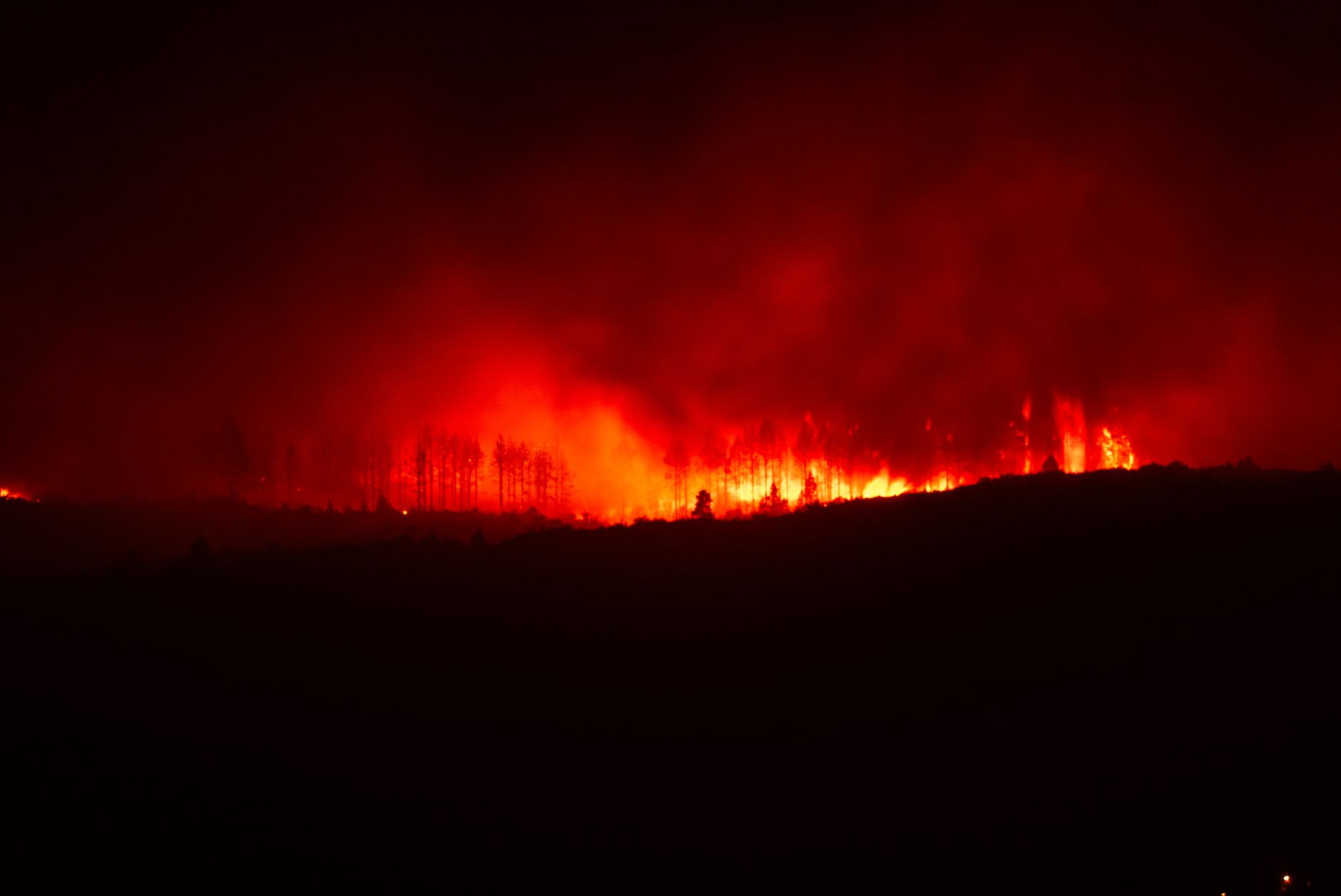
The second half is a descent into pure psychedelia and brutal violence. Red forges a battle axe, drinks an entire bottle of vodka in a single bathroom scene (Cage's finest unbroken close-up in years), and kills his way through every cultist and demon between himself and Jeremiah Sand. The film's palette shifts from amber to crimson. Everything bleeds. The chainsaw duel between Cage and a cult enforcer is shot like a fever dream: slow, mythological, backlit in red smoke.
Nicolas Cage and the art of going all the way
Cage's performance is the one that gets discussed in isolation, usually with words like "unhinged" attached, but that reading misses what he's doing. The grief scene, shot in a bathroom entirely in close-up, is one of the most genuinely raw moments in his career. He's not performing grief. He's performing what's left after grief burns away everything that looks like composure. It's ugly. It's correct.
In the film's violent second half, Cage shifts into something operatic, and Cosmatos wants that register exactly. The violence in Mandy isn't realistic; it's ritual. It needs to feel like mythology, not consequence. Cage's willingness to commit fully, without protective irony, is what allows the film to function as tragedy rather than exploitation. Compare this to a film like Hereditary (2018), which asks its lead performers to hold the same kind of raw exposure in a horror frame: both films use grief as detonator, not as decoration.
The cult as horror vehicle
Linus Roache's Jeremiah Sand is one of horror's most precise portraits of narcissistic male authority. He's a failed folk singer who uses cult machinery to curate an audience that can't leave. His most disturbing scene isn't violent: it's the moment he plays Mandy an unreleased track from his failed music career and watches her laugh at it. He doesn't expect that. Nobody has ever said no to him before, not in the terms he can understand. What happens next is unforgivable, and Cosmatos films it without flinching.
The demon bikers, the Black Skulls, occupy a different register. They're not explained. They arrive. They're tall, leather-wrapped, and wrong in the way that cult-adjacent horror creatures always are: they feel summoned rather than hired. The film draws on the same folk-horror instinct you find in The Wicker Man (1973), where religious structures built by men tip into something genuinely inhuman at the edges.
Jóhannsson's score and the visual language
Mandy is one of those films where the score and the cinematography are doing as much work as the script. Jóhannsson's compositions function as emotional architecture. The score doesn't comment on scenes from outside them; it builds from inside the mood and pushes it somewhere further than the images alone can reach. The strings in the film's first half carry a tenderness that makes the violence feel more catastrophic than any amount of bloodshed could achieve on its own.
Cosmatos and cinematographer Benjamin Loeb shoot everything at magic hour, or in total red dark, or in that specific shade of synthetic indigo that looks like the inside of a nightmare about 1983. There's almost no natural white light in the film. Every scene is a colour. The deliberateness of that choice keeps the film from feeling accidental: this is a constructed world, and the construction is the point. It recalls the chromatic intensity of Suspiria (1977), where colour functions not as atmosphere but as argument.
What the film is actually about
Red doesn't save Mandy. He avenges her. That distinction matters. The film doesn't pretend he can get her back. It doesn't offer the comfortable lie of resurrection. What it offers is something older and stranger: the idea that love, when it has nowhere left to go, becomes a kind of violence that the world has to accommodate. Red's chainsaw rampage isn't cathartic in the Hollywood sense. It's an act of grief that has taken a form the world can see.
By the end, when Cosmatos films Cage driving through a red dawn with Mandy's face floating in the windshield, the film has made its case. Mandy is gone. She's also everywhere. The film is a monument built from grief and noise and colour, and it holds its shape.
Mandy was produced by SpectreVision and released by RLJE Films in 2018. It earned back its $6 million budget and then some, and it found an audience that has treated it as a cult object ever since. It deserves the status. Not many horror films this decade have committed this completely to a single, ferocious vision, and fewer still have earned it.