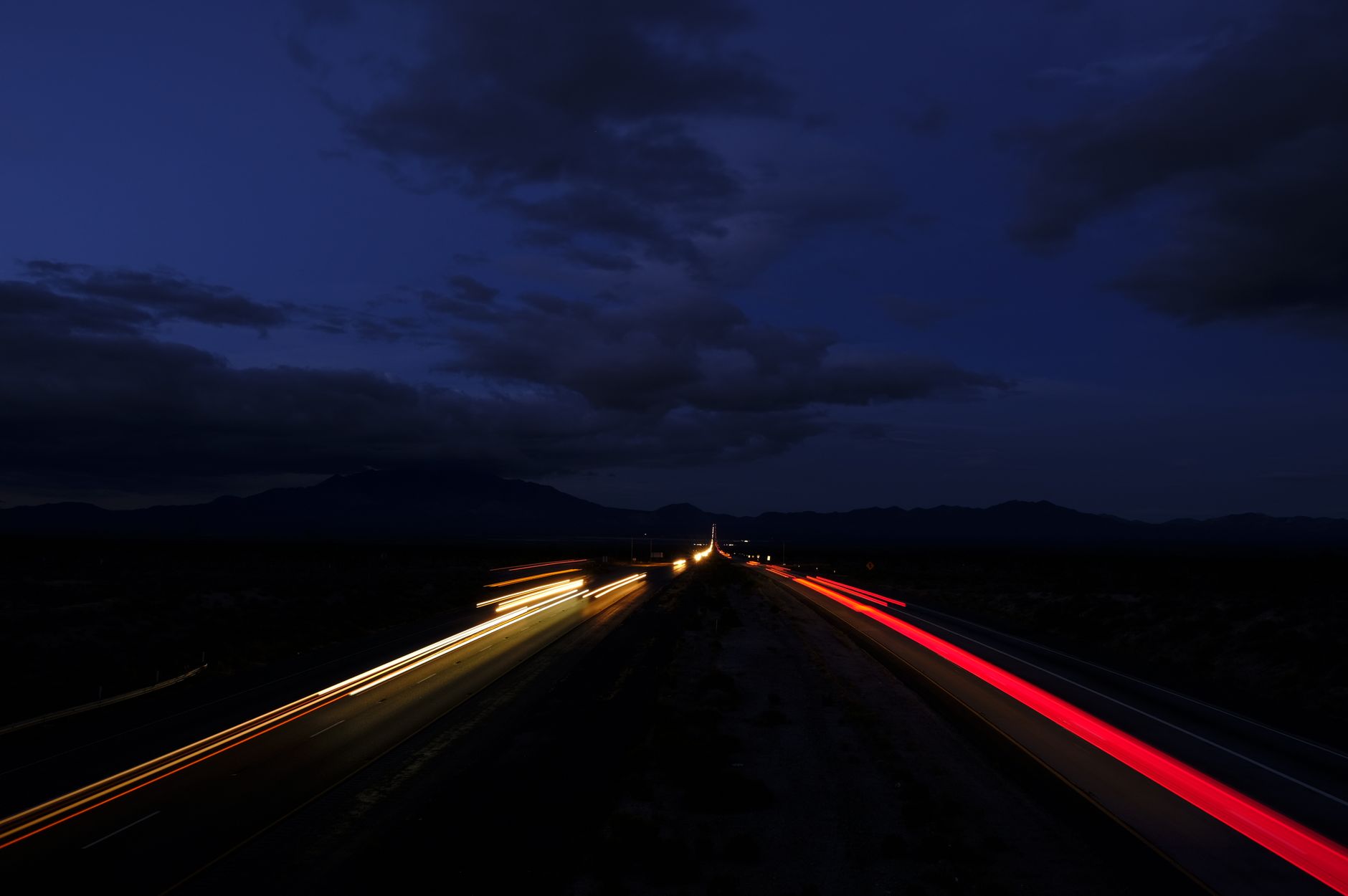
A road in a horror film is never just a road. It's a promise that movement equals safety, and the genre's job is to prove that promise wrong. The car fills up, the map comes out, and somewhere between the last petrol station and the next one, things stop making sense. Horror understands that a journey is simply a haunted house you can't stop moving through.
What the road takes away
The road strips its characters of the two things horror needs to remove: community and familiarity. The domestic space at least has rooms you recognise. But a road at night, in a region you don't know, with a fuel gauge drifting toward empty, leaves you with nothing except the windscreen and whatever the headlights decide to show you. It's the same logic that makes confined spaces so effective, except the walls are made of darkness rather than plaster.
Horror films set on or beside roads work in two registers. The first is isolation: the journey takes the characters so far from anywhere that help becomes theoretical. The second is transit, the idea that moving through a space doesn't mean you control it. You can drive at 80 miles an hour and still be trapped. The road becomes a corridor that scrolls past your windows while something waits at the end.
The hitchhiker and the wrong turn
Two figures haunt the road movie's horror variant: the hitchhiker and the wrong turn. Both are reversals. The hitchhiker looks like a human being asking for help and turns out to be the thing the driver should have feared. The wrong turn looks like a navigational mistake and turns out to be an invitation you can't decline.
The Hitcher, Rutger Hauer's 1986 road horror, makes this explicit. John Ryder isn't just a villain. He's what the highway produces when you drive far enough without sleeping. The road doesn't deliver you to him by accident. It selects you. This is the film's cruelest idea: that picking up a stranger is not a failure of judgment but a failure of the journey itself.
Wrong Turn (2003) works differently but from the same premise. The detour isn't unlucky. It's structural. The road has a region the map doesn't mark, and the film's horror comes from understanding that maps are fictions. You think you know where you are because a line on paper told you so. The road knows otherwise.
Speed as false comfort
Horror on the road often uses speed as a trap. The characters believe velocity equals escape. They floor the accelerator, and for a moment, they're right: the thing in the rear-view mirror gets smaller. Then the tyre blows. Or the road curves. Or the car simply runs out of road.
Duel (1971), Steven Spielberg's debut feature, is the purest expression of this. A salesman drives a California highway and attracts the attention of a tanker truck with no visible driver. The film runs for 90 minutes on a single idea: that speed is not safety. The truck is always faster. The road is always longer. David Mann drives harder and harder and ends up exactly where the road intended. What makes Duel remarkable is what it withholds: a motive, a face, a reason. The truck just is. The road just is. Neither cares about David Mann's destination.
Compare that to the horror of moving vehicles more broadly, where the vehicle becomes a haunted house on wheels and the journey's end is the least frightening thing about it. In Duel the terror is simpler. The road has selected you, and no amount of driving gets you un-selected.
The uncanny destination
Some road horror works not through pursuit but through arrival. The journey is uneventful. You reach the place. And the place is wrong in ways you can't immediately name.
This is the structure of The Texas Chain Saw Massacre (1974), which begins as a road trip. Five young people in a van, heading to a family property, stopping to pick up a hitchhiker. The drive is mundane. The horror begins when the driving stops. Tobe Hooper understood that the journey's normalcy was the weapon. You relax on the road because nothing is happening yet. The house is where it happens.
Midsommar (2019) works on the same principle extended to its logical extreme: the horror doesn't start until the journey ends, and by then you're so far from home that the journey back is unthinkable. Ari Aster gave his characters a flight, a drive through Swedish countryside, and a walk across a meadow before the first real wrongness reveals itself. Each stage of travel removes another safety net.
The road at night
Night transforms a road. The same tarmac that felt neutral in daylight becomes something else entirely when the headlights are the only light source for miles. Horror knows this and uses it obsessively. The horror of the night road is specifically the horror of the visible-but-limited: you can see 50 metres ahead, and absolutely nothing beyond that. What steps into the light from the darkness on either side is not something you could have prepared for.
Jeepers Creepers (2001) puts something ancient on a rural highway and lets it establish its territory. The road feels different once the creature has used it. The characters keep driving, keep trying to outrun something that uses roads differently than they do. It doesn't need fuel. It doesn't need directions. The road is its hunting ground, not their escape route.
This distinction matters. For the human characters, the road is infrastructure. For the monster, it's habitat. That inversion is what gives road horror its specific dread. You built these roads, and something else has moved in.
The road as point of no return
Horror films frequently use a specific moment on the journey to mark the transition from safety to danger: the last town, the last phone signal, the last open business. After that point, the road becomes one-directional. You can still physically turn around, but the film makes clear you won't. Something about crossing that threshold commits you.
This is similar to what weather does as a horror device: the storm that closes the road, the fog that removes the landmarks, the snow that makes turning back as dangerous as going forward. Weather and geography collaborate to make the journey irreversible. The road stops being infrastructure and starts being a sentence.
The Vanishing (1988), George Sluizer's Dutch-French thriller, begins at a service station. Rex and Saskia stop on a French motorway, and Saskia disappears into a crowd of ordinary travellers. The road was full of people. That's the horror: the journey didn't isolate her. It put her among strangers and then removed her anyway. The road doesn't need darkness or remoteness. It just needs transit. Movement is enough.
Roadside architecture
What the road passes matters as much as the road itself. Diners, motels, service stations, churches, abandoned properties: the horror genre has a whole vocabulary of roadside structures, and each one carries its own dread. The motel is a temporary shelter with thin walls and strangers next door. The diner is a local space that marks you as outsider the moment you walk in. The service station is the last civilisation before the road takes you somewhere it has decided to take you.
The roadside motel does something specific: it's shelter that doesn't belong to you, in a place you chose only because the road made you need it. Norman Bates runs a motel because a motel's guests arrive exhausted, transient, and carrying cash. They're road people. They've already been softened up by the journey.
Horror has always understood that the roadside stop is never neutral. You don't stop because you want to. You stop because the journey requires it. That compulsion is what the genre exploits.
Getting there is half the horror
The road in horror functions as a machine for removing options. Each mile driven is a mile not retreated. Each turn taken is a direction not reversed. The journey accumulates commitment the way debt accumulates interest, and by the time the destination reveals itself, you've already given the road everything it needed from you.
What makes road horror distinct from haunted house horror is the absence of walls. There's nothing between you and the dark except glass and speed and the assumption that the road goes where you think it goes. The house at least makes the horror architectural. On the road, the horror is everywhere you're not looking, which is most of the world.